
Ever opened a closet full of clothes and still felt like you had nothing to wear?
Maybe your favorite jeans are always in the laundry, your tops don’t quite work with your pants, or you own several pieces that looked wonderful in the store but never feel right at home.
A capsule wardrobe can help solve that problem.
Instead of constantly adding new clothes, you create a smaller, thoughtfully selected collection of pieces that work together, suit your lifestyle, and make getting dressed easier.
The best part? You don’t have to throw away half your closet, spend hundreds of dollars, or dress entirely in beige.
This guide explains how to build a capsule wardrobe from scratch, choose versatile essentials, create a color palette, and put together outfits you’ll genuinely enjoy wearing.
What Is a Capsule Wardrobe?
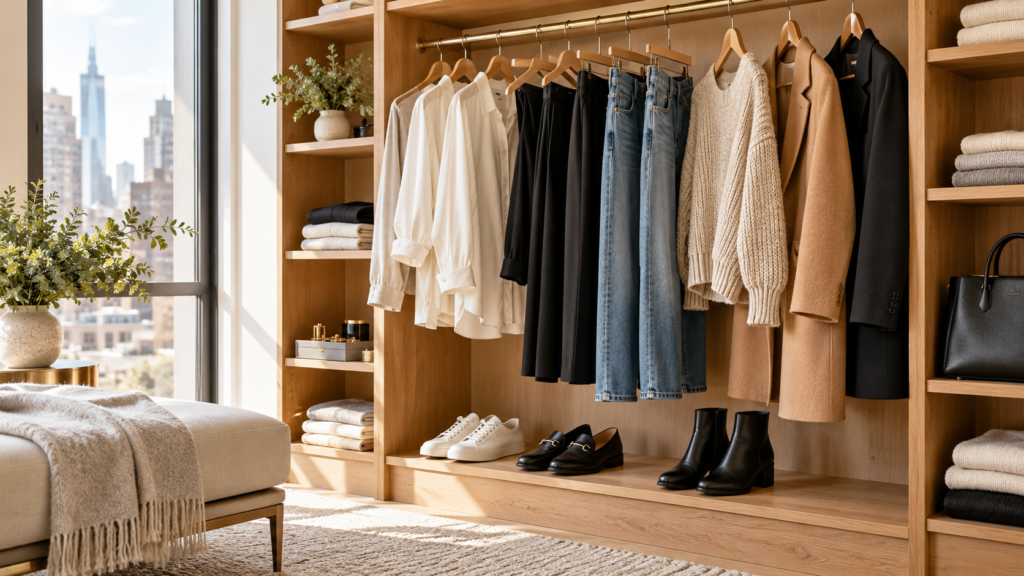
A capsule wardrobe is a curated collection of clothing that can be mixed and matched to create different outfits.
The idea is simple: keep the clothes you regularly wear, choose pieces that complement one another, and reduce the number of items that sit unused.
A capsule wardrobe typically emphasizes:
- Versatile clothing that works with multiple outfits.
- Comfortable, well-fitting essentials.
- A consistent but flexible color palette.
- Pieces appropriate for your lifestyle and climate.
- Quality, durability, and personal preference over impulse purchases.
For example, a pair of dark straight-leg jeans might work with a white T-shirt and sneakers on Saturday, a button-down shirt for the office, or a fine-knit sweater and ankle boots for dinner.
That’s three different outfits built around one useful piece.
How Many Clothes Should Be in a Capsule Wardrobe?
There’s no universally correct number.
Some people enjoy working with around 30 to 40 pieces, while others need significantly more because of their jobs, climate, or daily activities.
A practical beginner’s starting point is roughly 25 to 40 main clothing pieces, excluding underwear, sleepwear, workout-specific clothing, and accessories.
But treat that as a planning tool, not a rule.
Someone working from home in a warm climate may need a very different wardrobe from someone commuting through Canadian winters or working in a formal office.
Your capsule should fit your life, not someone else’s spreadsheet.
Why Build a Capsule Wardrobe?
A capsule wardrobe isn’t just about owning fewer clothes. It’s about making the clothes you own more useful.
Getting Dressed Becomes Easier
When most of your tops work with most of your bottoms, you spend less time wondering what matches.
You can put together reliable outfits without starting from zero each morning.
You Can Shop More Intentionally
A capsule wardrobe encourages you to identify what’s missing before making purchases.
Instead of buying another trendy top, you might realize that one comfortable pair of trousers would make several existing outfits more wearable.
Your Personal Style Becomes Clearer
Editing your wardrobe helps you notice patterns.
Perhaps you consistently choose relaxed denim, structured jackets, soft knitwear, or earthy colors.
Those preferences can become the foundation of a recognizable personal style.
You May Reduce Unnecessary Purchases
Buying fewer items can reduce spending, but only when you resist the temptation to replace your entire wardrobe at once.
The most budget-friendly capsule wardrobe often starts with clothes you already own.
How to Build a Capsule Wardrobe From Scratch in 8 Steps
You don’t need a professional stylist or an expensive shopping budget.
Start with your current wardrobe, understand your routine, and make a few deliberate decisions.
Step 1: Understand Your Actual Lifestyle
Before choosing clothes, consider where you spend most of your time.
Your wardrobe should reflect your real schedule, not an imagined version of your life.
Ask yourself:
- Do I work from home, commute, or wear a uniform?
- How often do I need professional outfits?
- Do I prefer casual clothing or polished looks?
- What is the weather like where I live?
- How frequently do I do laundry?
- Which outfits make me feel most comfortable?
For example, someone who works remotely four days a week probably needs more comfortable everyday clothing than formal officewear.
If you live somewhere with cold winters, layering pieces and weather-appropriate outerwear deserve more attention.
Beginner tip: Look at your calendar from the past two weeks. It may reveal more about your clothing needs than any capsule wardrobe inspiration board.
Step 2: Audit Your Current Closet
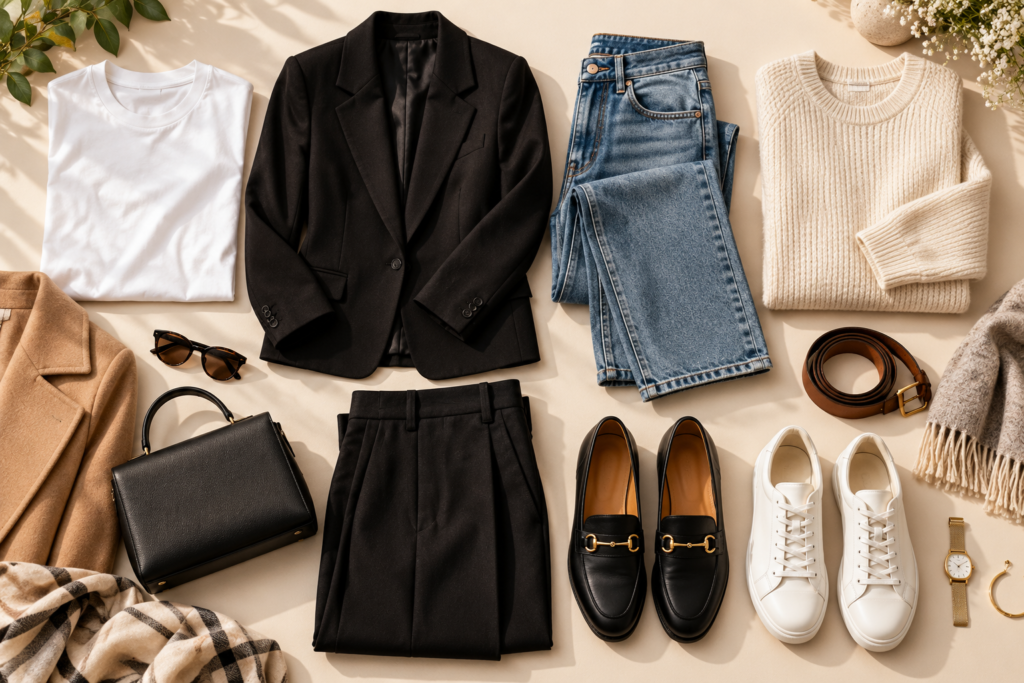
This is where the real transformation begins.
Take your clothing out of the closet and organize it by category: tops, bottoms, dresses, layers, outerwear, and shoes.
Then create four groups:
- Keep: Clothes you love, wear regularly, and feel comfortable in.
- Maybe: Pieces that need styling, alterations, or another try-on.
- Repair or tailor: Clothing that could become useful with a small fix.
- Donate, resell, or recycle: Items you no longer need or realistically expect to wear.
Don’t rush to discard clothes simply because they don’t fit a minimalist aesthetic.
A bright pink blazer you wear constantly deserves a place in your capsule more than a beige jacket you never reach for.
Also, keep sentimental pieces separately if you want to preserve them without including them in your everyday rotation.
Step 3: Choose Your Capsule Wardrobe Color Palette
A coordinated color palette makes mixing and matching easier.
You don’t need to wear only neutrals, but selecting a few repeat colors can create more outfit combinations.
A beginner-friendly approach is to choose:
- Two or three base neutrals: Black, navy, charcoal, cream, beige, or brown.
- Two complementary colors: Olive, burgundy, dusty blue, chocolate, or another shade you enjoy.
- One optional accent color: A brighter shade that adds personality.
For example, a capsule might combine black, cream, and denim blue with olive green and burgundy.
That palette works across casual clothing, knitwear, outerwear, and accessories.
Example Capsule Wardrobe Color Palette
| Color role | Example | Best used for |
|---|---|---|
| Primary neutral | Black | Trousers, jackets, shoes |
| Secondary neutral | Cream | T-shirts, sweaters, shirts |
| Supporting neutral | Denim blue | Jeans, casual layers |
| Complementary color | Olive green | Shirts, jackets, knitwear |
| Accent color | Burgundy | Sweaters, scarves, accessories |
Choose colors that flatter your preferences and work with what you already own.
There is no need to replace perfectly good clothing to create a coordinated wardrobe.
Step 4: Build Around Versatile Essentials
Now identify the pieces that form the foundation of your wardrobe.
Start with clothes you can style in at least three different ways.
A plain T-shirt, for example, might work under a blazer, with jeans, or tucked into a midi skirt.
A well-fitting pair of trousers might transition from work to dinner simply by changing your shoes and top.
Beginner Capsule Wardrobe Checklist
The following 30-piece example is designed for a casual-to-smart-casual lifestyle. It is not a universal shopping list.
| Category | Suggested pieces | Quantity |
|---|---|---|
| Tops | 3 basic T-shirts, 2 button-down shirts, 2 versatile tops, 2 knit tops | 9 |
| Bottoms | 2 jeans, 2 tailored or casual trousers, 1 skirt or shorts | 5 |
| Dresses or one-piece outfits | 2 versatile dresses or jumpsuits | 2 |
| Layers | 2 sweaters, 1 cardigan, 1 blazer, 1 casual jacket | 5 |
| Outerwear | 1 weather-appropriate coat | 1 |
| Shoes | 1 everyday sneaker, 1 boot, 1 flat or loafer, 1 dressier shoe | 4 |
| Accessories | 1 everyday bag, 1 belt, 1 scarf, 1 versatile accessory | 4 |
| Total | 30 |
This count includes shoes and accessories. The number of actual clothing garments is 22.
You can swap dresses for extra trousers, replace a blazer with a casual overshirt, or adjust the shoe selection for your climate.
The point isn’t to own exactly 30 items. It’s to create a functional collection.
Step 5: Prioritize Fit, Comfort, and Fabric
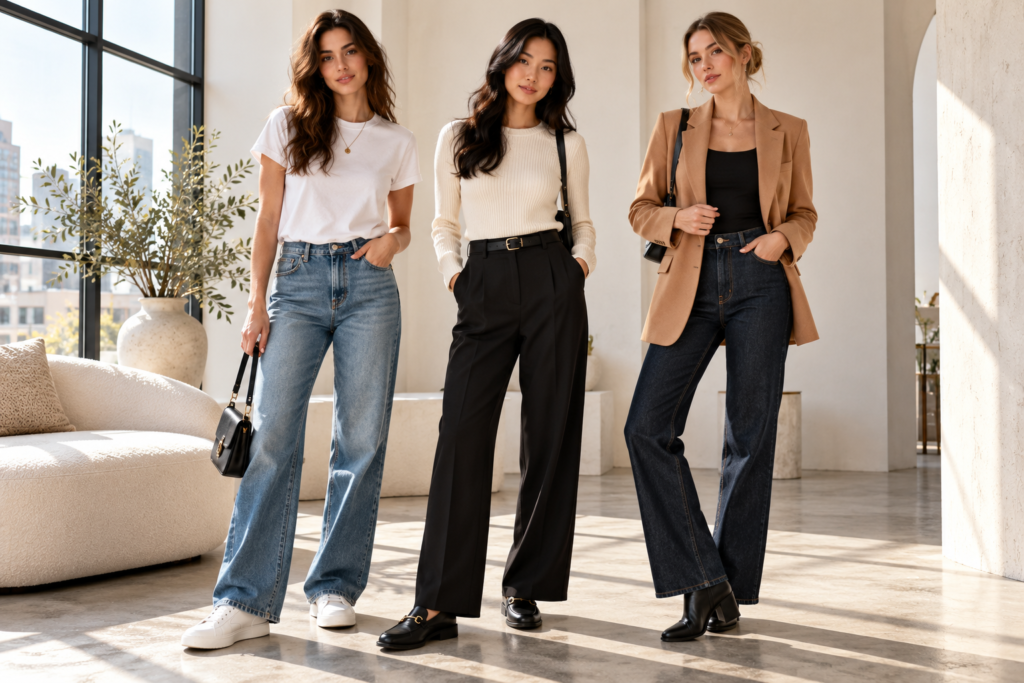
A wardrobe essential is only essential if you actually enjoy wearing it.
Before keeping or buying something, check:
- Does it fit comfortably when sitting, walking, and moving?
- Can I wear it with at least three existing pieces?
- Does the fabric suit my climate?
- Can I maintain it without excessive effort?
- Will I realistically wear it in the next few months?
Pay attention to garment construction.
Look for secure seams, functional closures, appropriate fabric weight, and care instructions you can follow.
Natural fibers such as cotton, linen, and wool can be useful depending on the garment, but fabric performance also depends on construction, blends, and care.
Don’t assume that every expensive garment is durable or that every affordable piece is poor quality.
A useful test: Try the item with three different outfits before removing the tags.
Step 6: Create Outfit Formulas You Can Repeat
An outfit formula is a simple clothing combination that works consistently.
Instead of planning every outfit from scratch, you repeat a reliable structure with different pieces.
Here are five easy formulas:
Formula 1: Casual Everyday
Straight-leg jeans + basic T-shirt + white sneakers + lightweight jacket.
Formula 2: Smart Casual
Tailored trousers + fitted knit top + loafers + structured bag.
Formula 3: Relaxed Weekend
Wide-leg jeans + oversized sweater + ankle boots.
Formula 4: Polished Workwear
Button-down shirt + tailored trousers + blazer + comfortable flats.
Formula 5: Simple Evening
Dark jeans + elegant top + dressier shoes + minimal accessories.
The same trousers, sweaters, and jackets can appear in several formulas.
This is how a relatively small wardrobe can support a wide variety of looks.
Step 7: Shop for Gaps, Not for a Completely New Closet
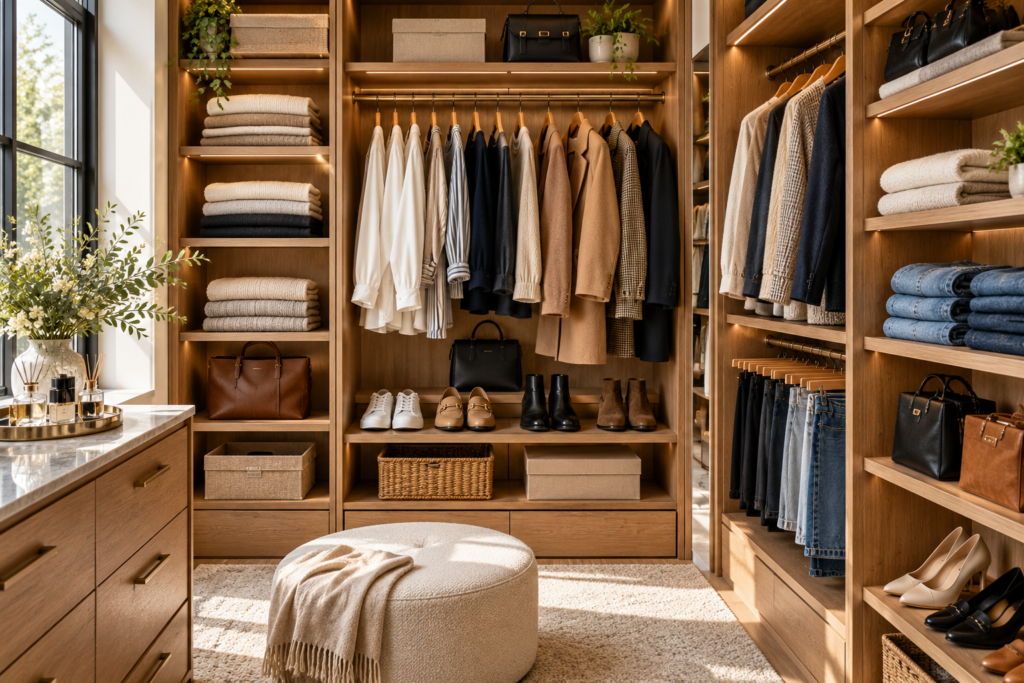
Once you’ve organized your existing clothes, identify what’s genuinely missing.
You might discover that you have plenty of tops but only one comfortable pair of trousers.
Or perhaps your everyday outfits work well, but you need a reliable jacket for transitional weather.
Make a short shopping list and prioritize pieces that solve actual problems.
How to Build a Capsule Wardrobe on a Budget
Try these strategies:
- Shop your own closet before buying anything.
- Set a spending limit for each missing category.
- Consider secondhand or resale options.
- Repair or tailor clothing that is almost right.
- Compare quality, comfort, and care requirements.
- Avoid buying something solely because it’s discounted.
- Spread purchases over several months if possible.
One helpful way to evaluate an item is to estimate its cost per wear.
For example, a $90 pair of trousers worn 90 times costs approximately $1 per wear.
A $30 top worn only three times costs $10 per wear.
These are illustrative calculations, not guarantees about future use. The goal is to think about how often you’ll realistically wear something.
For more context on clothing longevity and reuse, the U.S. Environmental Protection Agency’s textiles information provides background on textile waste and material management.
Step 8: Test Your Capsule Wardrobe for 30 Days
You don’t need to finalize your capsule immediately.
Use your selected clothes for a month and observe what happens.
Notice:
- Which pieces you wear repeatedly.
- Which outfits feel comfortable.
- Which garments are difficult to style.
- Whether you have enough clothes between laundry days.
- What you keep wishing you had.
Keep a simple note on your phone whenever you discover a genuine wardrobe gap.
At the end of the month, make small adjustments.
A successful capsule wardrobe is not a finished project. It changes with your needs.
How to Create More Outfits With Fewer Clothes
The real strength of a capsule wardrobe comes from combining pieces in different ways.
Consider these seven versatile items:
- White T-shirt
- Black fitted top
- Blue jeans
- Black tailored trousers
- Cream cardigan
- Black blazer
- White sneakers
With just these pieces, you can create several outfits.
| Outfit | Combination | Occasion |
|---|---|---|
| 1 | White T-shirt + jeans + sneakers | Casual day |
| 2 | Black top + trousers + blazer | Office or meeting |
| 3 | White T-shirt + trousers + cardigan | Smart casual |
| 4 | Black top + jeans + blazer | Dinner or outing |
| 5 | White T-shirt + jeans + blazer | Polished weekend |
| 6 | Black top + trousers + cardigan | Everyday workwear |
These combinations demonstrate how versatile basics can reduce the need for entirely separate outfits.
Accessories, outerwear, and different footwear can create even more variation.
Capsule Wardrobe vs. Minimalist Wardrobe: What’s the Difference?
The two concepts overlap, but they aren’t exactly the same.
| Capsule wardrobe | Minimalist wardrobe |
|---|---|
| Focuses on creating coordinated outfits | Focuses on reducing unnecessary possessions |
| Can include seasonal rotations | May remain consistent throughout the year |
| Often uses a selected group of interchangeable pieces | Doesn’t necessarily require a specific capsule system |
| Can include colorful or statement clothing | Can also include color, depending on personal preference |
| Prioritizes versatility and practical styling | Prioritizes intentional ownership and simplicity |
You can have a colorful capsule wardrobe without identifying as a minimalist.
Likewise, you can own relatively few clothes without organizing them into a formal capsule.
How to Adapt Your Capsule Wardrobe for Every Season
A year-round capsule wardrobe works best when it includes flexible core pieces and seasonal additions.
Spring
Focus on lightweight layers, breathable tops, jeans, comfortable shoes, and a transitional jacket.
A cardigan or trench-style coat can help you adjust to changing temperatures.
Summer
Choose clothing appropriate for your local heat and humidity.
Breathable shirts, lightweight trousers, shorts, dresses, and comfortable sandals may become more useful than heavy layers.
Fall
Introduce knitwear, darker denim, closed-toe shoes, and jackets.
Many spring pieces can continue working through fall with a few adjustments.
Winter
Prioritize warmth and weather protection.
Depending on your climate, that may mean thermal base layers, insulated coats, warm knitwear, waterproof boots, and winter accessories.
A capsule wardrobe in Toronto will naturally look different from one in Sydney.
Practical tip: Store off-season pieces separately rather than donating clothes you’ll need again in a few months.
Common Capsule Wardrobe Mistakes to Avoid
Buying Everything at Once
A capsule wardrobe shouldn’t become an excuse for an expensive shopping spree.
Start with what you own and purchase missing pieces gradually.
Copying Someone Else’s Exact Checklist
A social media creator’s wardrobe might look beautiful but be completely impractical for your routine.
Use inspiration as a starting point, not a strict shopping requirement.
Choosing Clothes That Don’t Feel Like You
If you dislike blazers, you don’t need one simply because it appears on every capsule wardrobe checklist.
A comfortable overshirt or cardigan might serve the same purpose.
Ignoring Laundry and Weather
A very small wardrobe can become inconvenient if you don’t have enough clean clothes between laundry days.
Your capsule should make life easier, not create extra work.
Removing Every Statement Piece
Minimal doesn’t have to mean boring.
Keep the colorful jacket, patterned dress, or distinctive shoes you genuinely love.
Personal style matters more than achieving a perfectly coordinated closet photograph.
Is a Capsule Wardrobe More Sustainable?
A capsule wardrobe can support more thoughtful clothing consumption, especially when it helps you buy fewer unnecessary garments and wear existing pieces longer.
However, owning a small wardrobe doesn’t automatically make someone’s fashion habits sustainable.
Replacing useful clothes with brand-new minimalist essentials can create additional consumption.
The more meaningful approach is to maintain garments, repair items when practical, buy secondhand when suitable, and make purchases based on real needs.
The Ellen MacArthur Foundation’s fashion work explores circular approaches to clothing, including keeping products and materials in use.
For additional consumer guidance, the WRAP organization provides resources on extending clothing life and reducing textile waste.
The goal is not simply to own fewer clothes. It’s to make better use of the clothes you have.
Your First 7 Days: A Simple Capsule Wardrobe Starter Plan
If building an entire capsule feels overwhelming, break the process into smaller tasks.
| Day | Your task |
|---|---|
| Day 1 | Review your lifestyle and most-worn outfits |
| Day 2 | Sort your tops and bottoms |
| Day 3 | Review layers, outerwear, and shoes |
| Day 4 | Choose a practical color palette |
| Day 5 | Build five outfits using existing clothes |
| Day 6 | Identify missing essentials and set a budget |
| Day 7 | Organize your closet and photograph favorite outfits |
By the end of the week, you’ll have a clearer understanding of your wardrobe, even if you haven’t purchased a single new item.
Frequently Asked Questions
1. How do I start a capsule wardrobe with no money?
Start by organizing clothes you already own. Identify your most versatile pieces, create repeatable outfit combinations, and repair items where possible. A capsule wardrobe doesn’t require buying anything new.
2. How many items should a beginner capsule wardrobe have?
Around 25 to 40 pieces can be a useful starting point, but there is no mandatory number. Your ideal wardrobe depends on your lifestyle, climate, laundry routine, and clothing preferences.
3. Can a capsule wardrobe include bright colors?
Absolutely. A capsule wardrobe doesn’t have to be neutral. You can include bright colors, patterns, and statement pieces as long as they work with the outfits you enjoy wearing.
4. Do I need a separate capsule wardrobe for every season?
Not necessarily. Many core pieces can work throughout the year. You can rotate seasonal clothing such as heavy coats, summer dresses, and weather-specific footwear when needed.
5. What are the most important capsule wardrobe essentials?
Useful essentials often include comfortable jeans, versatile trousers, basic tops, knitwear, practical shoes, and weather-appropriate layers. The exact selection should reflect your daily activities.
6. Can I build a capsule wardrobe if I love fashion trends?
Yes. A capsule wardrobe can include trendy pieces. Keep your core wardrobe versatile and add a small number of trend-driven items that complement your existing clothes.
7. How often should I update my capsule wardrobe?
Review it whenever your lifestyle, climate, fit needs, or preferences change. A seasonal check-in is helpful, but there’s no need to replace items on a fixed schedule.
Final Thoughts: Build a Wardrobe That Works for You
Learning how to build a capsule wardrobe from scratch is less about reaching a perfect clothing count and more about understanding what you actually wear.
Start with your favorite pieces. Choose colors that work together. Build a few dependable outfit formulas, and make thoughtful purchases only when you discover genuine gaps.
Most importantly, leave room for personality.
A good capsule wardrobe should feel comfortable, practical, and unmistakably yours.
Your first step today: Choose ten items you already love and see how many outfits you can create. You may be surprised by how much of your ideal wardrobe is already hanging in your closet.




3 thoughts on “How to Build a Capsule Wardrobe From Scratch: A Beginner’s Guide”