
By Olivia Parker
Choosing between curtain bangs and wispy bangs starts with a simple visual question: do you want your fringe to open around your face, or fall lightly across your forehead?
Curtain bangs usually separate around a center or near-center part, with longer sides that sweep into the haircut. Wispy bangs have a light, separated finish, often with small gaps of forehead showing between the strands. The categories can overlap, which is why two photos labeled “wispy bangs” can show quite different cuts.
Quick answer: Consider curtain bangs if you want an open center and longer face framing. Consider a forward-falling wispy fringe if you want light forehead coverage. Ask about wispy curtain bangs if you like the outward sweep but prefer a less substantial fringe. Your hairline, natural texture, and tolerance for styling should help decide the details.
What Changes in the Shape and Forehead Coverage?
The easiest comparison is to look at the fringe with the rest of the hair pulled back. Where does it separate? Where do its shortest pieces finish? How much forehead remains visible?
Hair.com’s curtain-bangs guide describes the familiar middle opening and sideways sweep. That opening is the defining feature; curtain bangs do not have to be thick, dramatically curled, or perfectly symmetrical.
Wispy bangs are better recognized by their lightness and broken outline. A forward version places small sections across the forehead without creating a solid horizontal edge. “See-through bangs” is a related term you may encounter, although salon terminology varies.

| Detail | Curtain bangs | Forward-falling wispy bangs |
|---|---|---|
| Front arrangement | An opening around a part, with hair moving toward the sides | Light sections falling across the forehead |
| Forehead coverage | Usually more exposed through the center | Partly covered, with visible gaps between strands |
| Side pieces | Commonly lengthen into the surrounding haircut | Can blend into the sides or remain a distinct fringe |
| Fullness | Can be light or substantial | Deliberately airy in appearance |
| Styling goal | Establish the opening and the outward fall | Arrange the light pieces without excessive lift or clumping |
| Length | Varies; longer versions offer more sweeping options | Varies; brow-length versions need attention as they approach the eyes |
Where wispy curtain bangs fit
Wispy curtain bangs combine a parted shape with a lighter finish. They can suit someone who likes seeing their forehead through the fringe while still wanting shorter pieces around the face.
The name alone leaves several decisions unresolved. Bring a photo that shows the opening width, the shortest dry length, and how the sides connect. Those details make the request much clearer.
Choose for Your Hairline, Density, and Texture
Start with the way the front grows
Notice where your hair separates after your normal wash-and-dry routine. A natural opening may help a curtain shape settle, while a strong lift or swirl at the front can complicate either version.
Sam Villa’s cowlick-styling tutorial explains that blow-drying can temporarily redirect the hair; it does not permanently change the growth pattern. If maintaining a particular opening would mean resetting the roots every morning, include that work in your decision.

Ask your stylist to assess the front before wetting or straightening it. A fringe that cooperates in its usual wearing state gives you a more realistic starting point.
Separate fine strands from lower density
As Redken’s guide to hair type explains, fine hair describes the diameter of individual strands. Density describes how many hairs grow across an area. You can have fine strands and plenty of hair, or coarser strands with lower density.
A wispy fringe does not automatically suit every person with fine hair. If very little hair is brought forward, the result may look sparser than you wanted. Taking a deeper section changes how much hair remains available around the sides.
Ask to see the proposed fringe section before it is cut. If preserving fullness is a priority, discuss the fringe and the rest of the haircut together. Our guide to choosing a haircut for your hair texture explains how strand thickness, density, and natural movement work together.
Dense hair brings a different question: how will the stylist create the desired lightness while keeping an outline you like? “Wispy” should describe the agreed result, rather than serve as a vague request to remove lots of hair.
Plan around waves, curls, and coils
Both styles can be adapted to textured hair, but a smooth blowout photo cannot show how your fringe will sit in its natural pattern. Decide whether you want to wear the front curly, stretched, or straightened most often.
Hair.com’s curly-bangs guidance recommends assessing a dry cut when shrinkage is a concern. Ask your stylist to agree on the resting dry length and check the fringe in the texture you intend to wear. A curly curtain fringe can open through the middle without forming two smooth, matching wings.
Decide Where You Want the Fringe to Sit
Face-shape labels can be a starting point, but they leave out the choices you will actually see in the mirror: the opening, the width, and where the ends land.
For a round face, consider whether you prefer the diagonal lines of longer curtain pieces or the lighter forehead coverage of a wispy fringe. For a longer face, decide how much of the forehead you want visible. A square jaw does not oblige you to choose a soft fringe, and an oval face does not make every fringe equally convenient. These are aesthetic preferences, not corrective rules.
If you wear glasses, bring them to the consultation. Check the fringe while looking down as well as straight ahead. Brow-length pieces can catch on the upper rim; longer curtain sides may meet the temples of the frames. Agree on whether the hair should sit above, beside, or clear of those points.
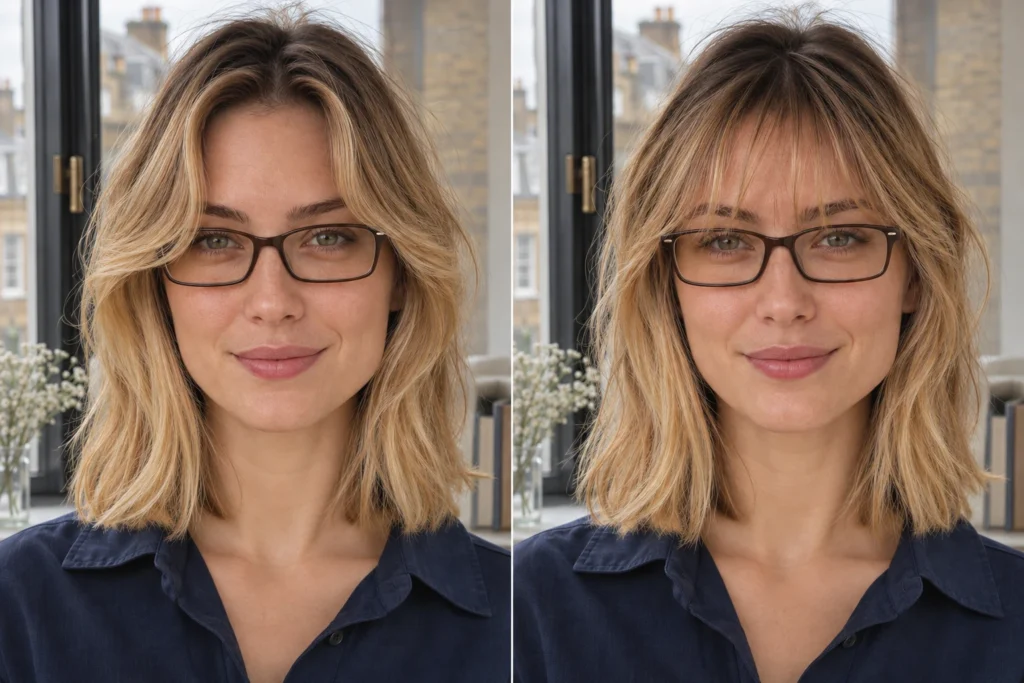
Think about the whole haircut, too:
- With a blunt bob: A light forward fringe adds a broken edge above a more defined bottom line. Longer curtain pieces create a different transition around the cheeks.
- With a lob: Decide whether the side pieces should remain distinct or blend gradually toward the shoulder-length hair.
- With long layers: Ask where the fringe ends and the face framing begins, especially if you regularly tie your hair back.
If you are changing the main haircut at the same time, our guide to bob shapes for different hair types can help you assess the overall outline before adding a fringe.
How to Style Curtain Bangs
For a smooth or softly blow-dried finish, focus on the roots first, then the bend through the ends. Repeatedly curling the tips will do little to change a part that has already dried in an unwanted position.
- Isolate the fringe. Clip back the longer hair so you can see the section you are styling.
- Reset only what needs attention. Lightly dampen the roots if they have dried out of place. Apply a heat protectant according to its directions when using heat.
- Create a shallow curve. Once excess moisture has dried, use a suitable round brush to give each side a gentle bend away from the face. Keep the dryer moving and use gentle tension.
- Release and let it cool. Allow the hair to settle before arranging the opening with your fingers.

Choose a brush the fringe can sit over comfortably. Short pieces may not catch on a large barrel; tightly winding longer pieces around a small one can produce more curl than you intended.
The American Academy of Dermatology’s hair-care advice recommends limiting heat styling, using low or medium settings, and applying a heat-protective product. A heat protectant does not make repeated hot-tool passes harmless.
For alternatives and troubleshooting, see our fuller guide to styling curtain bangs at home. If you usually wear curls or coils, have your stylist demonstrate the opening using your normal curl routine.
Shop the inspiration: choose a brush by fringe length
The Olivia Garden NanoThermic Round Thermal range includes several barrel sizes, including the NT-34. It is one option to compare if you need a round brush; use the size your stylist demonstrates rather than assuming one diameter works for every fringe. An existing brush that gives you the right curve may already be sufficient.
View the Olivia Garden brush range
How to Style Wispy Bangs
For a forward-falling wispy fringe, aim for a light arrangement that leaves the gaps you actually want. A little separation is part of the look; a fringe gathered into a few large sections may need refreshing.
Start with clean hair, lightly dampening the fringe if it needs reshaping. For a blow-dried finish, use low airflow and gently guide the pieces toward their intended position. Add only a small bend through the ends if needed, then let them cool before separating them with your fingers.

Avoid giving a short fringe so much lift that it rolls away from the forehead. If that happens, reset it with a gentler curve. If the hair repeatedly springs up at the same point, ask whether the cut and growth pattern are working together.
Keep product placement precise. A rich cream that works well on dry lengths may leave a light fringe more coated than you want. Adjust the amount to the small section you are styling and follow the product’s directions.
If the front becomes oily while the rest of the hair still feels clean, washing just the fringe can be a practical refresh. Let its appearance and your scalp’s needs guide the frequency. A heat-free option is to dampen and arrange it, then allow it to dry naturally; the result will follow your texture more closely than a blowout.
Shop the inspiration: an option for heat-styling days
Davines MELU Spray is a leave-in spray whose official product information includes heat protection. Consider it if it matches your hair’s needs, and follow the current packaging directions. You do not need several finishing products to make a light fringe look separated.
These are shopping suggestions for the styling routine, not exact products depicted in the editorial illustrations. The linked storefronts are U.S. pages; the Olivia Garden store specifies U.S.-only shipping. Readers elsewhere should check local brand stockists.
Compare Trims, Refreshing, and Growing Them Out
Count both the appointments you book and the small adjustments you make at home. A light fringe may dry quickly yet need regular shortening. A longer curtain fringe may accept more growth while still requiring you to arrange its part.
For a starting conversation, Hair.com suggests roughly four to six weeks for maintaining curtain bangs, while Davines suggests around three to four weeks for wispy bangs. These are published guidelines, not deadlines for every haircut.
| Maintenance question | Curtain bangs | Forward-falling wispy bangs |
|---|---|---|
| What may need resetting? | The opening, root direction, or outward bend | The position of the light pieces or excess clumping |
| What signals a trim? | The side blend or sweep no longer sits as intended | The shortest pieces interfere with the eyes or lose the agreed outline |
| What happens during grow-out? | Longer pieces can gradually join the face framing | Forward pieces may need sweeping or pinning as they pass eye level |
Ask whether your salon offers separate fringe appointments and what those visits cost. Agree on a schedule after the stylist has seen the actual cut, your growth pattern, and how much change you are happy to accommodate.

For growing out bangs, keep a couple of small clips or pins available. Longer curtain sides may tuck behind the ears before the shorter center does. Wispy bangs can eventually be parted and swept aside, but the transition depends on their starting length and shape.
If your priority is a small styling commitment across the whole cut, our guide to low-maintenance haircuts for fine hair helps put the fringe decision in context.
What to Ask Your Stylist Before Cutting Bangs
Bring a clear front view and a side view of the fringe you like. Include a photo of your own hair after an ordinary wash day so the consultation covers your everyday starting point.
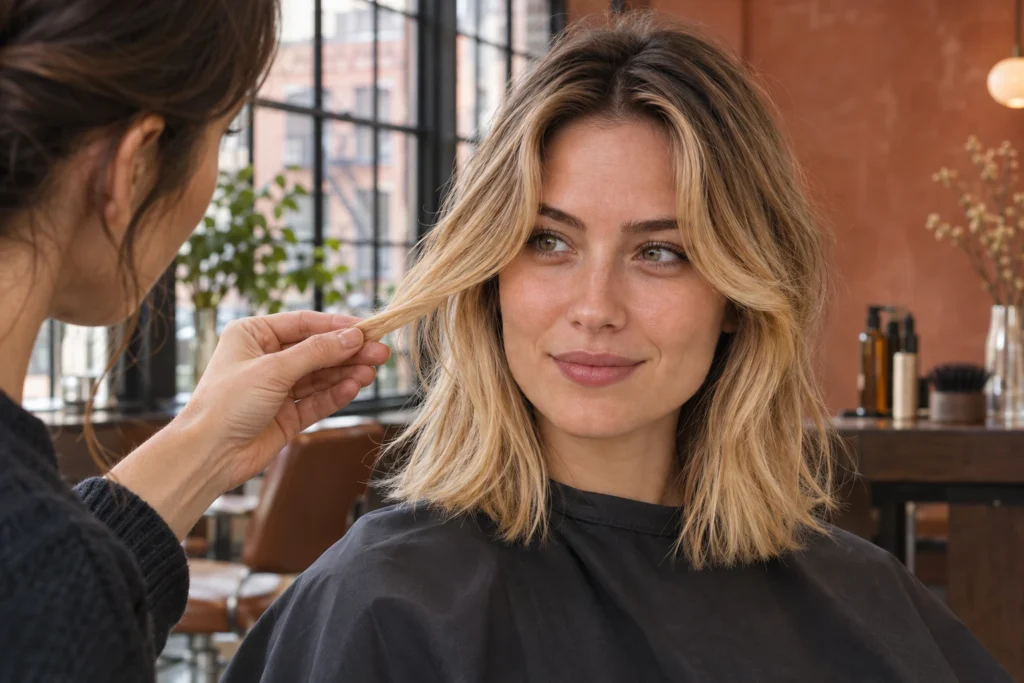
Resolve five details before cutting:
- The shortest dry length: Show where you want the center to finish with the hair resting naturally.
- The opening: Decide whether the fringe should part, fall forward, or allow some movement between the two.
- The amount of hair: Ask to see the proposed width and depth of the section.
- The side connection: Agree on how the fringe should meet your bob, lob, or longer layers.
- The routine: Explain whether you air-dry, blow-dry occasionally, wear glasses, or need to secure the front for work and exercise.
A curtain-bang brief might be: “I want a soft opening near my usual part, with sides that blend into the haircut. Please show me the shortest length before cutting.”
A wispy-bang brief might be: “I want light coverage across the forehead with visible gaps, while keeping enough hair at the sides. I would like to check the finished length dry.”
For the hybrid, ask for a lightly filled-in curtain shape and identify exactly how much center coverage you want. Finish by asking the stylist to demonstrate one routine you can realistically repeat.
Frequently Asked Questions
Can you switch between curtain bangs and wispy bangs with the same cut?
Sometimes. A longer, light fringe may be worn partly forward or opened at the center. A very short forward fringe will have fewer sweeping options, and long curtain pieces may not sit like brow-length wispy bangs. Ask what your proposed cut can do before relying on styling to change its shape.
Can you try the look without cutting your hair?
Clip-in bangs can help you judge forehead coverage, especially if the color and texture resemble your hair. They cannot predict how your own roots or cowlicks will behave. Treat them as a visual preview, then discuss the practical details at a consultation.
Which bangs are easier for workouts and humid weather?
Length and your securing options matter. Longer pieces give you more scope to sweep or pin them back, although they may still be too short for a ponytail. For either style, agree on a finish you can accept when your natural texture shows through. No fringe cut guarantees the same shape after sweat or humidity.
Should you get bangs immediately before a wedding or other big event?
Allow an opportunity to wash and style the cut yourself before the occasion. That gives you time to assess its natural fall, try your accessories, and request an adjustment if needed. Avoid depending on an unfamiliar salon finish as your only reference for the day.
The most useful choice is the fringe whose shape and routine both appeal to you. Bring your reference photo, your glasses if you wear them, and an honest account of your usual mornings. Agree on the opening, dry length, and amount of hair before the scissors come out.