
By Olivia Parker
A haircut can look exactly right worn loose and feel inconvenient the first time you try to get it off your neck. That is the useful starting point for the bob vs. lob decision: how much length do you want to see, and how much do you need to keep?
A bob generally finishes around the jaw to above the shoulders; a lob, short for long bob, usually reaches the shoulders or collarbone. A lob offers more scope for tying back, while a shorter bob puts more emphasis on the outline. The practical difference comes from the shortest pieces and your preferred finish.
Before choosing, consider your usual hairstyle on a busy day, the finish you enjoy wearing, and how often you want to return for reshaping. Those details reveal more than a photograph of a freshly styled cut.
Bob vs. Lob: The Length Difference
A lob belongs to the bob family. The distinction is primarily length, with some overlap in how salons use the names. ELLE SALON’s bob-versus-lob guide describes shorter bobs around or below the jaw and lobs around the shoulders or collarbones.
Use those descriptions to begin the consultation, then establish the actual endpoint on your own hair.
| Detail | Shorter bob | Lob |
|---|---|---|
| Typical finished length | Around the jaw to above the shoulders | Around the shoulders to collarbone |
| Visible outline | The edge is prominent around the face and nape | The edge sits lower, closer to clothing |
| Gathering the hair | Side clips or a half-up style may be more practical | A low ponytail may be possible if the shorter sections reach |
| Contact with shoulders | A sufficiently short cut can clear them | Ends may bend where they meet shoulders or a collar |
| Room to change the shape later | Less spare length for immediate adjustments | More length available if you decide to go shorter |
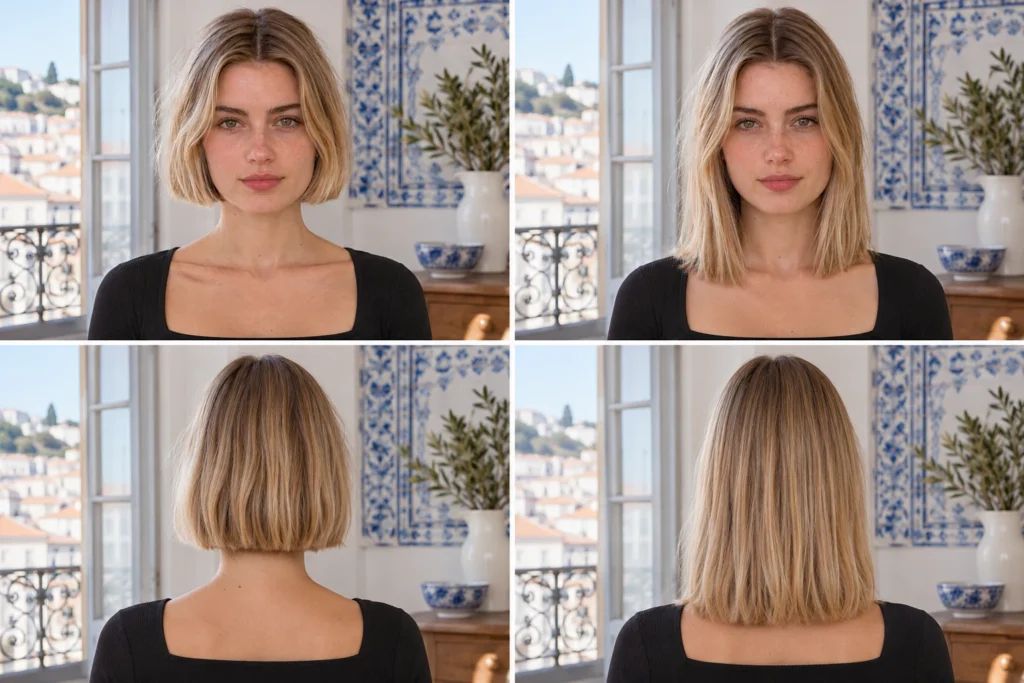
A front-view reference can conceal a closely cut nape. Ask to see the back before agreeing to an angled bob, especially if the long front pieces are what attracted you to it.
Also distinguish the haircut from its finish. A lob curled into loose bends may appear shorter than the same cut worn straight. Compare references with a texture you expect to wear regularly.
Tie-Back Options: A Ponytail, a Half-Up Style, or Clips?
“Can I tie it back?” needs a more specific answer than yes or no. Keeping the front away from your face is different from containing every section for work or exercise.
For a full ponytail, check three areas
Ask your stylist to assess the proposed cut at the fastening position you actually use:
- The front: Will the pieces beside your face reach, or will they need separate pins?
- The sides: Will the hair above and behind your ears stay gathered when you turn your head?
- The nape: Will the shortest back sections reach the tie without being pulled tight?
A low ponytail and a high bun make different demands on these sections. Being able to create one does not prove the other will work. A long front with a much shorter back can also look ponytail-friendly in a mirror while leaving the nape unsecured.
If your hair is currently long, tying it up before the appointment only establishes your preferred position. It does not demonstrate what the shorter cut will do. The stylist still needs to assess how much length each section will retain.
For partial tie-back, a bob has options
A small side twist, two discreet clips, or a half-up fastening can keep hair away from your eyes while leaving the lower section loose. That may be entirely sufficient for desk work or an evening out.
For variations that work with the length you already have, our easy hairstyles for medium-length hair explain how to adjust the fastening rather than force every piece into one tie.
Keep the roots comfortable. The American Academy of Dermatology’s hair-care guidance recommends loosely secured styles and covered hair bands instead of pulling hair back tightly.
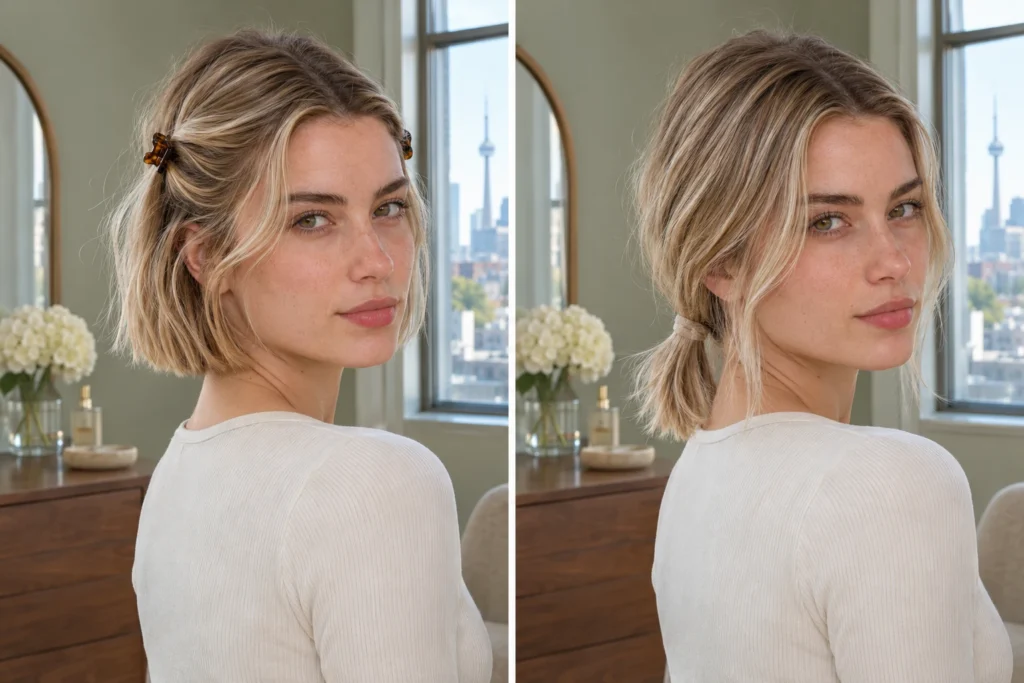
Shop the inspiration: Kitsch’s Black & Tort Cloud Claw Clips 6pc Set – Mini offers small clips for securing individual sections. Choose the amount of hair by whether the clip closes comfortably; a mini clip is a sectioning option, rather than a substitute for full containment.
View mini claw clips at Kitsch
The shopping links in this guide identify products to consider, rather than exact items documented in the illustrations. Check the relevant country storefront for local availability.
Texture and Density Change the Same Length
Length is only one part of the cut. The lower edge, the placement of layers, and the way your hair dries determine whether the shape feels manageable.
Fine strands or a sparse-looking perimeter
Fine hair describes strand diameter; density describes how many strands occupy an area of scalp. As Redken’s guide to fine and thin hair explains, these are separate characteristics.
If your ends already look sparse, discuss retaining a more continuous lower edge. Both a bob and a lob can have that outline. A shorter cut may bring the wispiest lengths into a firmer-looking line, but it is not automatically preferable if you value a ponytail.
Our guide to low-maintenance haircuts for fine hair explores that balance between a defined perimeter and everyday flexibility.
Dense hair or substantial volume at the sides
Describe where the bulk bothers you before asking for layers everywhere. You may want less width near the jaw while still enjoying a full lower edge.
A lob leaves more length below the face; a bob concentrates the silhouette higher. Either can be shaped. Ask the stylist to explain what an internal adjustment would change and whether any shorter sections would interfere with your tie-back plans.
Waves, curls, and coils
Agree on where the cut should finish in the texture you wear most. Sam Villa’s curly-hair cutting guidance emphasizes assessing shrinkage and checking the finished shape on dry curls.

A wet or stretched section cannot tell the whole story. If you alternate between natural curls and a straightened finish, establish which version takes priority when choosing the length.
Our guide to choosing a haircut for your hair texture can help you prepare those details. Separately, blunt cuts versus layers addresses how the shape is constructed. You do not have to choose “bob and blunt” or “lob and layered” as fixed packages.
Maintenance: Daily Styling and Salon Visits
The easier haircut depends on which part of maintenance you want to reduce.
Daily effort depends on the finish
A short bob gives you less length to wash and dry, but a precise turned-under edge may need attention if your hair naturally bends another way. A lob may take longer to dry while allowing you to gather it on a morning when you skip styling.
Think about the correction you are willing to make. Are you comfortable resetting one front section? Do you enjoy a full blowout? Would a natural outward turn at the ends bother you?
For air-drying, ask to see a reference with believable natural movement. A glass-smooth salon finish does not establish how either length will settle at home.
If you use heat, the American Academy of Dermatology advises using the lowest heat setting, reducing frequency, and limiting contact with hot tools. Repeatedly straightening a shoulder flick is an extra styling commitment to consider before choosing that endpoint.

Shop the inspiration: Bumble and bumble’s Heat Shield Thermal Protection Hair Mist is an option for a routine that includes heat styling on dry hair. The brand directs users to shake it and apply it to dried hair before styling. Follow the current label; a heat-protection product is not a reason to increase the temperature.
View Heat Shield at Bumble and bumble
Salon upkeep depends on how exact you want the outline
For a sharp classic bob, hairstylist Marc Ballance suggests roughly six-week haircuts in Cosmopolitan’s bob-versus-lob comparison. Treat that as a planning reference for a defined shape, rather than a rule for every bob.
A softer shape may allow more flexibility. Decide whether you are maintaining a particular length or are happy to let it change between visits.
Before booking, ask what a maintenance appointment includes and what it costs. A haircut that needs little morning styling can still require a salon schedule you would rather avoid.
How Each Cut Fits Work, Exercise, and Special Occasions
Choose around the situations that recur, then plan for occasional styling separately.
For work: If you usually wear your hair loose, compare how each outline looks with your preferred neckline and parting. If your workplace requires all hair to be secured, make that requirement explicit during the consultation. A few loose face-framing pieces may be acceptable to you aesthetically while failing the practical requirement.
For exercise and warm weather: Explain whether your priority is clearing your eyes, your face, or your entire neck. A short bob can leave the neck exposed when worn down, but the sides may still need clips. A lob can offer a gathered option, provided the relevant sections reach. Test the planned style with normal head movement before relying on it.
For cold-weather clothing: Bring the collar into the decision. A lob can catch against a high coat collar or scarf; a shorter bob may sit above it. If you like the lob’s length, accepting a slight bend or gathering it before putting on outerwear can be easier than correcting the ends afterward.
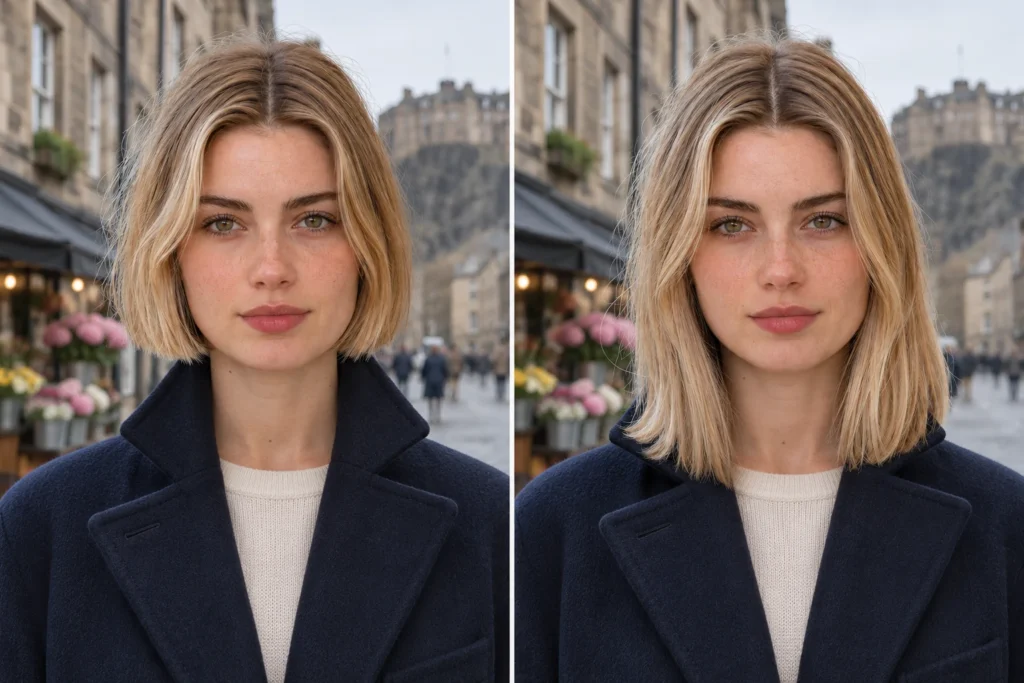
For weddings and evenings out: A bob can be styled with a changed part, an ear tuck, or a decorative side accessory. A lob leaves more material for pinned styles, but an elaborate updo may still need extra support or length. Share the haircut and desired updo with the event stylist before assuming they are compatible.
The Salon Brief: Four Details to Agree On
Bring a front view, a side or back view, and a photograph of your own hair in its usual finish. Each answers a different question: the look you like, the construction you want, and the starting texture.
Then agree on four details:
- The dry endpoint: Show where the hair should sit when worn normally.
- The back shape: Specify whether you want a level outline, a longer front, or visible graduation at the nape.
- The shortest pieces: Discuss bangs and face-framing layers separately from the main length.
- The routine: State your tie-back needs, usual styling method, and preferred appointment frequency.
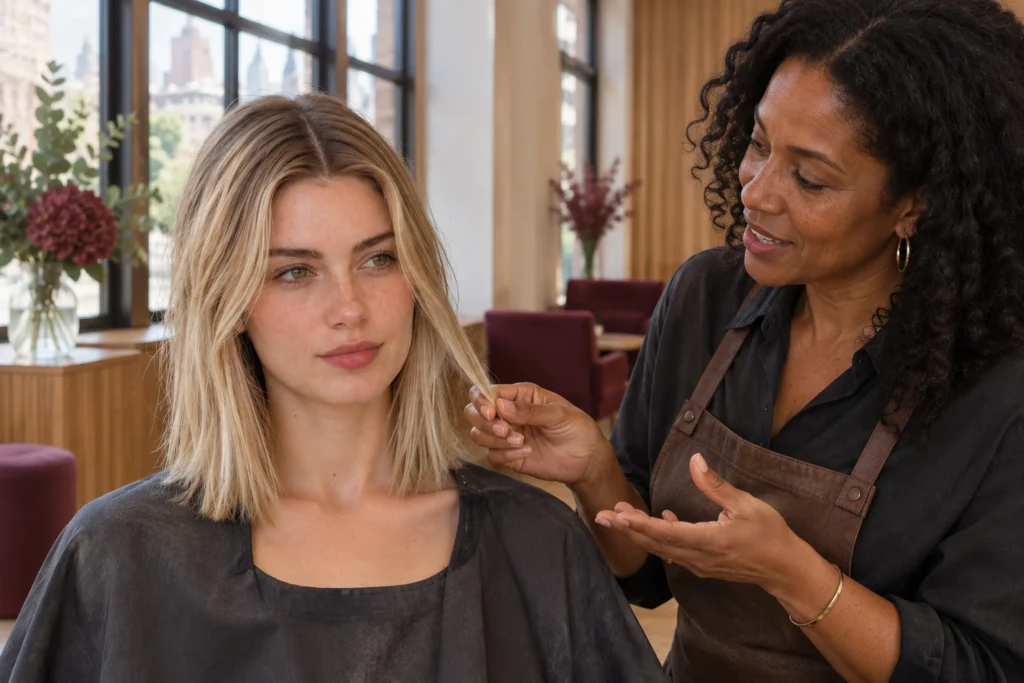
For a lob, a useful brief might be:
I want the outline near my collarbone in my usual dry texture. I wear a low ponytail for exercise, so please assess the front, sides, and nape for that position before shortening them. I am comfortable with a little movement at the ends, and I want to keep the front pieces long enough to secure.
For a bob, specify the compromise just as clearly:
I want a shorter outline below my jaw, and I am comfortable using side clips instead of a full ponytail. Please show me the back length and explain what I would need to do to recreate the finish.
If you need visual references for the construction, compare our bob haircuts for different hair types. Choose a reference for its shape rather than assuming the model’s styling result will transfer unchanged to your hair.
Going Shorter—or Growing a Bob Into a Lob
A lob can be a useful first cut when you are undecided about losing length. After wearing it through washing, work, exercise, and a few ordinary mornings, you will have a clearer idea of whether you miss the extra length or want a more compact shape.
Tell the stylist if a shorter bob may be your next step. The layering chosen now can affect the outline available at the next appointment.
Growing a bob into a lob needs a different brief: identify the length you want to gain and the parts of the shape you want to keep. If your bob has a distinctly shorter back, ask how the front and nape will be balanced as it grows. Repeatedly restoring the original short outline works against the longer destination.

There is no useful universal month-by-month promise here. Starting length, the cut’s construction, individual growth, and how much you trim all affect the transition.
Frequently Asked Questions
Is a lob the same as shoulder-length hair?
The terms overlap, but shoulder length describes an endpoint. A lob describes a longer bob-style cut, which can have a blunt, angled, or layered construction. Bring a picture rather than relying on the label alone.
Can either haircut have bangs?
Yes. Treat bangs as a separate decision about front length and styling. Our comparison of curtain bangs and wispy bangs explains the different shapes. Neither option changes whether the back of the cut can reach a hair tie.
Should a round face rule out a bob?
No. Instead of treating face shape as a prohibition, discuss the outline you enjoy: where the front ends, how much width you want at the sides, and which parting you prefer. Those choices can be adjusted within either length.
Can I keep my usual side part?
Ask for the cut to be assessed in that parting. If you switch sides regularly, demonstrate both. A reference styled with a center part may distribute the front differently from the way you wear it.
Choose a bob when you want the shorter outline and are comfortable with its tie-back limits. Choose a lob when retaining usable length matters more. Before the first cut, make sure you and the stylist agree on what the hair should do when you leave it loose—and when you need it out of the way.