
By Olivia Parker
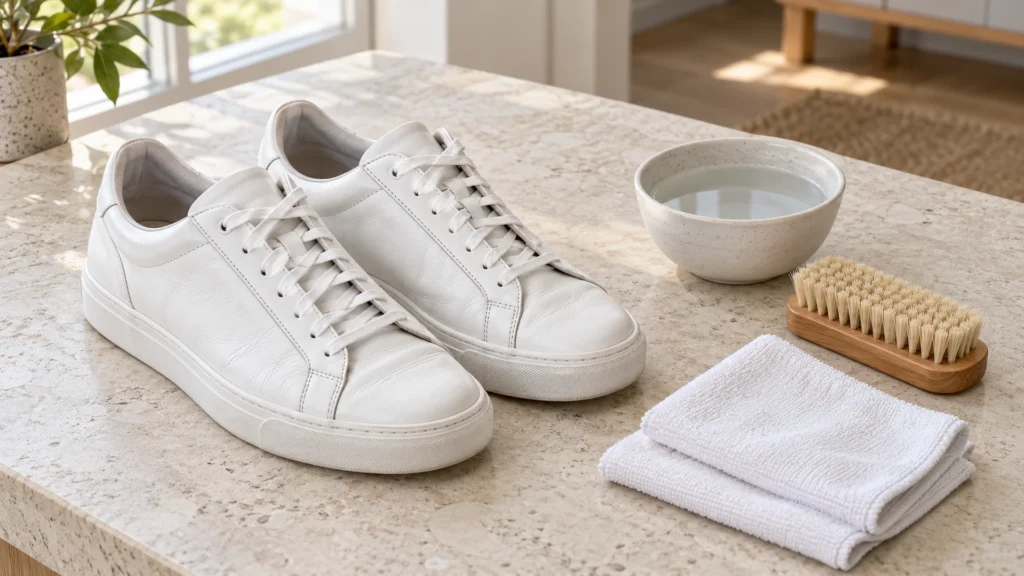
Learning how to clean white sneakers starts with knowing what they are made from. A gray mark on a rubber sole and a stain on white suede need different treatment. Treating the entire shoe as one washable surface can lead to a faded panel, roughened fabric, or a misshapen upper.
To clean white sneakers without damaging them, check the materials and care instructions first, remove loose dirt, then use the gentlest approved method. Smooth finished leather usually needs controlled wiping; washable canvas and mesh need light hand-cleaning; suede needs dry care first. Clean removable parts separately and let everything dry fully before wearing.
The aim is a clean, well-kept pair that still feels comfortable. Preserve the shoe’s finish, texture, and shape as you remove the dirt.
How to Clean White Sneakers: Start With the Material
Check the care label, original product page, or manufacturer’s instructions before choosing a cleaner. A white upper might be finished leather, coated synthetic material, canvas, mesh, suede, or several of these stitched together. Its color does not tell you how washable it is.
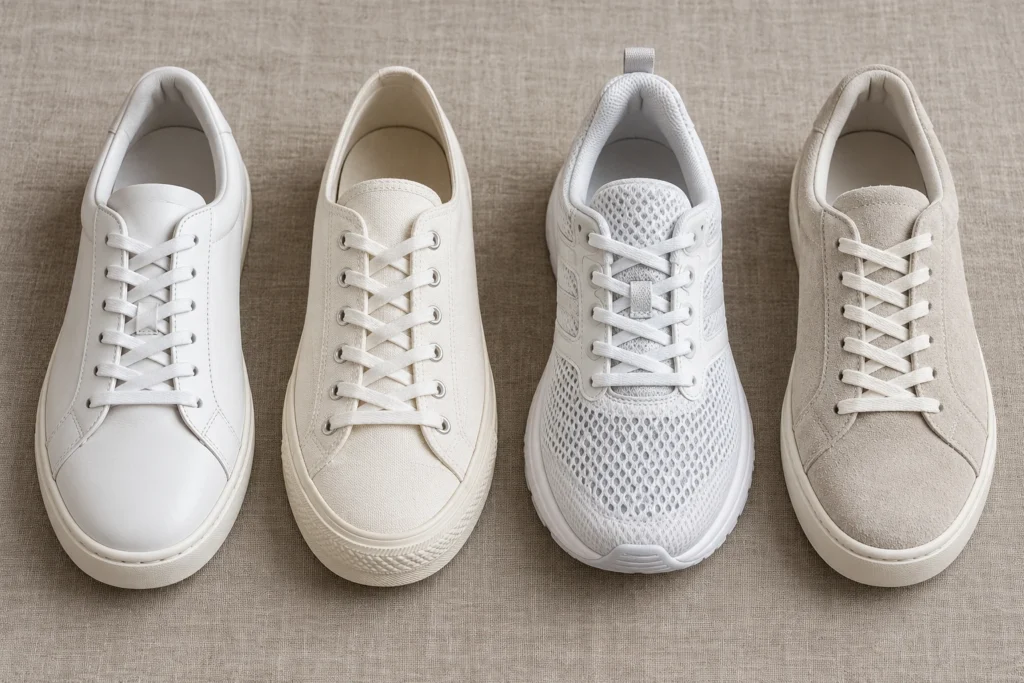
Use this as a starting point, then follow any instructions specific to your pair:
| Upper material | Sensible starting method | Main precaution |
|---|---|---|
| Smooth finished leather | Soft cloth with an approved cleaner or mild soap solution | Keep moisture controlled; avoid abrasive rubbing |
| Synthetic leather | Gentle wiping if the maker permits it | Protect the surface coating |
| Canvas | Light hand-cleaning with mild soap and a cloth or soft brush | Do not assume fabric means machine-washable |
| Mesh or knit | Gentle blotting and minimal brushing | Avoid snagging, stretching, and hot water |
| Suede or nubuck | Dry brush and an appropriate eraser first | Keep general wet-cleaning methods away |
| Mixed materials | Treat each panel according to its material | Protect neighboring panels too |
Gather a few simple supplies
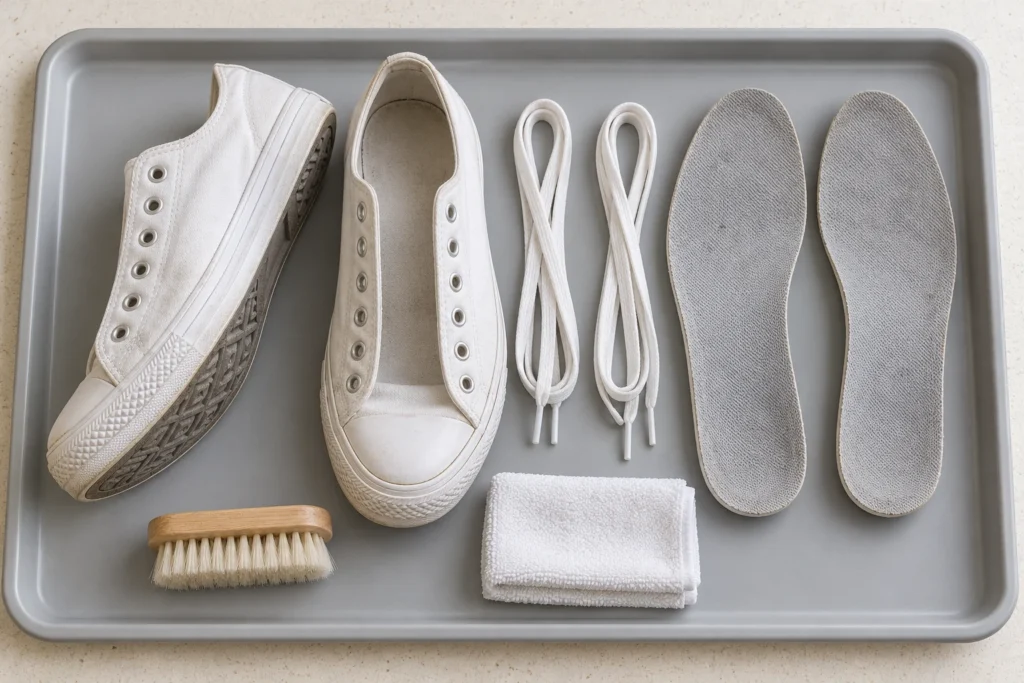
For most basic hand-cleaning jobs, you will need:
- A clean, soft-bristled brush.
- Two clean white cloths.
- A small bowl.
- Cool or lukewarm water.
- A mild cleaner suitable for the shoe’s material.
- Plain white absorbent paper for drying.
White cloths make it easier to notice dirt or color transferring as you work. Keep a separate brush or cloth for the soles so you do not carry grit back onto the upper.
Remove the laces. Take out insoles only if they are designed to come out; leave glued-in ones alone. Brush away loose dust and let ordinary mud dry before gently lifting it off.
Patch-test the cleaner in an inconspicuous area and let that spot dry before continuing. New Balance’s shoe-care guidance recommends mild, dye-free detergent, a light-bristle brush, and testing first.
Stop if you see color transfer, a changed finish, or a roughened surface. More pressure is unlikely to solve a compatibility problem.
Shop the Inspiration: The Jason Markk Delicates Cleaning Brush has a walnut handle and soft hog-hair bristles. It is an optional tool if you do not already own a suitable soft brush. The brand’s US storefront listed it at $10 USD when checked on October 24, 2026.
How to Clean White Leather Sneakers
For smooth uppers, put the cleaning solution on the cloth rather than pouring it onto the shoe. This makes it easier to work around seams, perforations, and the edge where the upper meets the sole.

For ordinary finished leather or synthetic uppers whose care instructions permit mild soap:
- Remove surface dust. Use a clean, dry cloth to lift away loose dirt.
- Prepare the cloth. Lightly dampen it with diluted mild soap and water, then wring it out well.
- Wipe gently. Work over a small area using light pressure. Refold the cloth as it picks up dirt.
- Remove the residue. Use a second lightly dampened cloth, then blot with a dry one.
Converse’s cleaning instructions recommend gentle cleaning with mild soap and lukewarm water for its leather shoes. Treat that as guidance for compatible finishes rather than permission to wet every leather sneaker.
Patent, metallic, hand-painted, and unfinished leathers may need different care. Follow the instructions supplied with the shoe or ask the maker before using a household cleaner.
Also distinguish a mark sitting on top of the surface from damage to the surface itself. A gray transfer mark may lift; a scraped coating will not become intact through more scrubbing.
If a white layer starts flaking or rubbing off, stop. A shoe-care specialist may be able to advise on repair, but repeated cleaning will not replace a damaged finish.
Clean Canvas, Mesh, and Knit Sneakers by Hand
Fabric sneakers can hold dirt between their fibers, but stronger scrubbing is not necessarily the answer. Work with a small amount of cleaning solution, lift away the loosened dirt, and check the result before repeating.
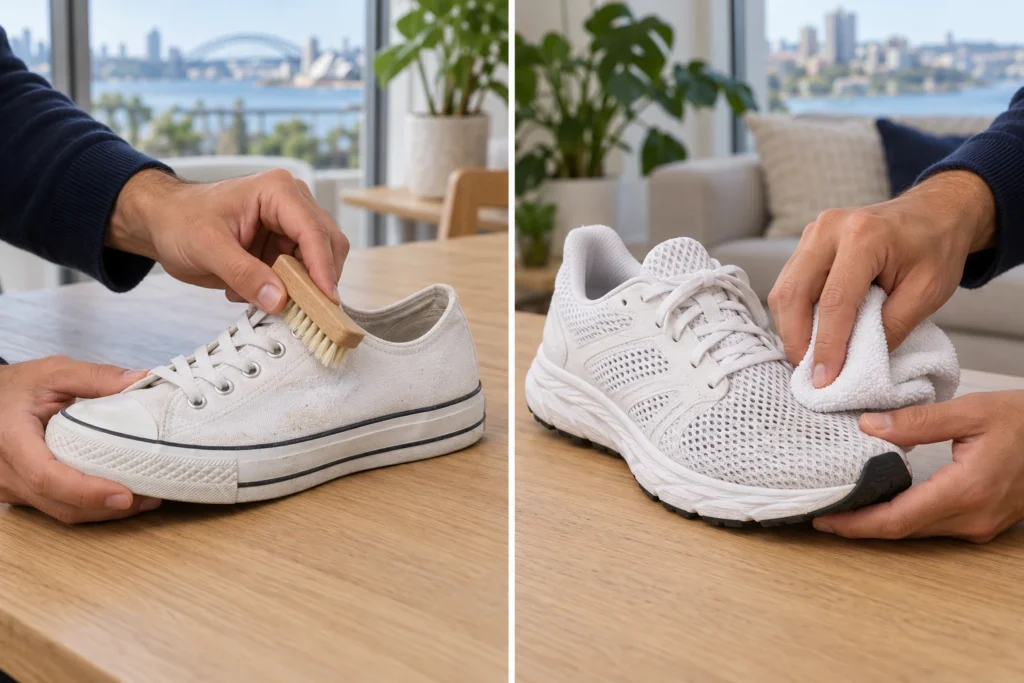
White canvas sneakers
To clean white canvas sneakers whose instructions permit mild soap, mix a little into lukewarm water. Use a soft cloth or soft brush to clean the affected area with light strokes.
Wipe away the loosened dirt and soap with a clean, damp cloth. Avoid repeatedly working a dirty cloth back over the same panel.
Pay attention to the boundary between the upper and the sole. The rubber edge may need a separate pass, but that does not justify scrubbing the canvas more aggressively.
Canvas construction alone does not make a shoe machine-washable. Converse, for example, specifically advises against machine washing its canvas sneakers.
White mesh and knit sneakers
To clean white mesh sneakers, support the upper from inside with your hand or a clean white cloth so it does not collapse or stretch as you work.
Start by gently blotting the surface. If the maker permits brushing, use a very soft brush with light pressure.
Nike’s mesh-shoe guide recommends a small amount of mild soap or detergent in cool or lukewarm water, while avoiding hot water and harsh chemicals.
Do not twist the upper, wring the shoe, or pick at a snag with a brush. Around embroidery, loose threads, or delicate overlays, reduce the pressure further.
After cleaning, lift moisture with a dry cloth. If the shoe still looks dirty, reassess once it has dried rather than immediately adding another cleaner.
How to Clean White Suede Sneakers
White suede sneakers need a different starting point from smooth leather or canvas. Begin with dry tools, and avoid carrying a wet brush straight from the sole onto a suede toe or heel panel.
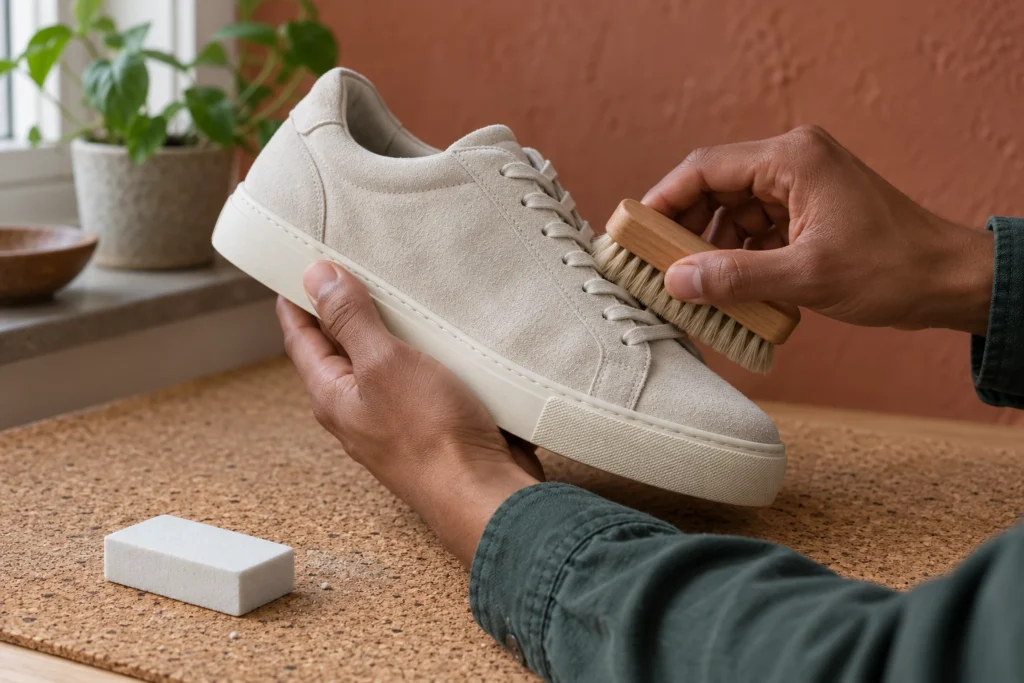
For light surface dirt:
- Let the suede dry. Allow wet or muddy areas to dry naturally before brushing.
- Remove loose dirt. Use a suitable suede brush with gentle strokes.
- Treat small marks carefully. Test an appropriate suede eraser on a discreet spot before lightly working on a mark.
- Restore the texture. Brush away the eraser debris and gently lift the nap.
Jason Markk’s suede-care tutorial starts with brushing and erasing before considering a material-specific foam treatment.
A dedicated cleaner still needs to be compatible with the shoe and used according to its instructions. A product being sold for sneakers does not mean it suits every material used in their construction.
Take extra care with mixed materials
On a shoe with a mesh body and suede overlays, the mesh-cleaning method may be unsuitable for the trim.
Clean permitted panels carefully and keep liquid away from adjoining suede. If you cannot isolate the areas, ask the brand or a shoe-care specialist for advice.
Oil stains, strong dye transfer, and persistent water marks are also reasons to pause. Repeated improvised treatments can make a valuable pair harder to restore.
Shop the Inspiration: The Jason Markk Premium Suede Cleaning Kit includes an eraser and a horse-hair brush with a beechwood handle. The brand’s US storefront listed it at $15 USD when checked on October 24, 2026. It is an optional dry-care tool set; follow its directions and your shoe manufacturer’s advice.
Clean Rubber Soles, Laces, and Insoles Separately
The upper may need only a light clean while the tread needs more attention. Separating the removable parts also lets you clean around the eyelets and dry the interior more thoroughly.
Rubber soles and sidewalls
Use a separate brush or cloth for the dirtier underside so you do not carry grit onto the upper.
Apply a mild cleaning solution to the tool, work over the tread and permitted sidewall areas, then wipe away the residue. Use controlled movements near the seam where the sole meets the upper.
Be careful with the assumption that every white sidewall is plain rubber. Some shoes have painted finishes, exposed foam, or decorative coatings.
Avoid abrasive pads and cleaning erasers unless the manufacturer approves them for that particular surface.
Nike’s general sneaker-cleaning guide covers cleaning the outsole and midsole separately, followed by gentle upper cleaning and blotting.
Shoelaces
For ordinary washable fabric laces:
- Remove them from the shoes.
- Gently work them through a mild soap solution.
- Rinse away the soap.
- Press out excess water with a clean towel.
- Lay them out to air-dry.
Leather, coated, elastic, and decorative laces may need different care.
If fabric laces are frayed or their tips have broken, replacing them can be more useful than repeatedly trying to whiten them. Match the original length and width so the replacement suits the eyelets.
Insoles
Clean removable insoles according to their own instructions, using controlled moisture rather than automatically soaking them. Let them dry completely before putting them back.
For orthotic or specialist inserts, follow the supplier’s care directions.
If an insole is crumbling, distorted, or persistently unpleasant after appropriate cleaning and drying, check whether a compatible replacement is available.
Dry Sneakers Thoroughly and Make the Next Clean Easier
A shoe can feel dry across the toe while its tongue, lining, and footbed are still damp. Give those areas time before relacing the shoes or putting them away.
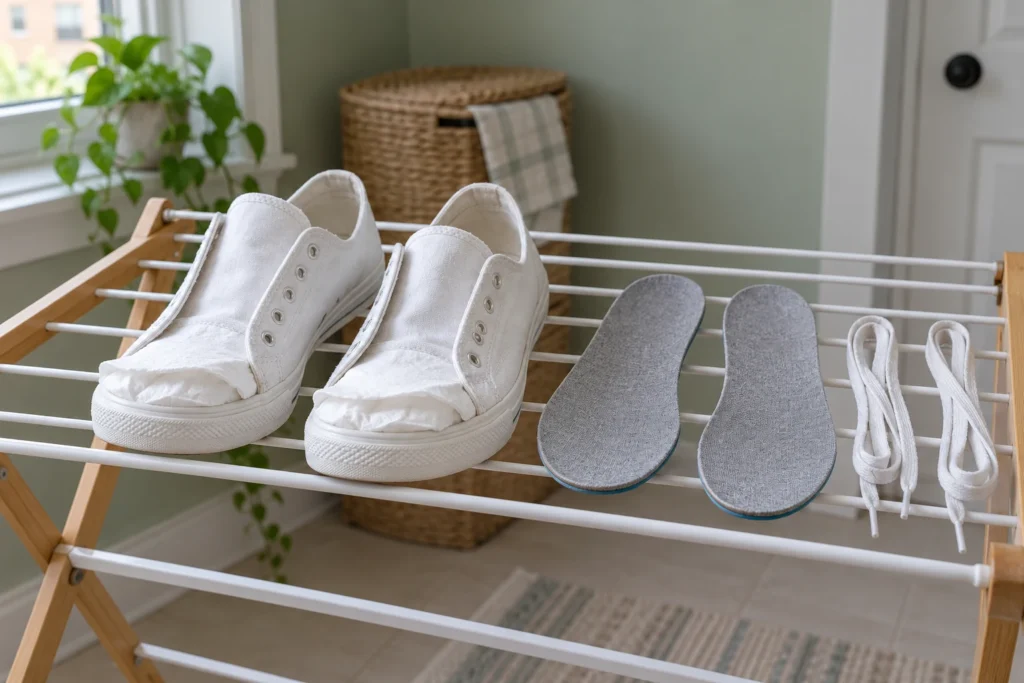
Blot excess moisture with a clean white towel. Loosely place plain white absorbent paper inside the toes to support their shape, replacing it when it becomes damp.
Do not pack the shoes so tightly that air cannot circulate.
Open the tongues gently and leave removable insoles and laces alongside the shoes. Dry at room temperature with good airflow.
Keep sneakers away from radiators, tumble dryers, hair dryers, and strong direct sunlight.
Adidas recommends air-drying shoes and laces at room temperature away from direct sunlight.
Avoid treating any drying estimate as a deadline. The amount of moisture, padding, and room conditions all matter. Check the interior before wearing.
Build a lighter maintenance routine
Between deeper cleans, give compatible smooth uppers a quick wipe when needed and brush dry surface dust from suede.
Let shoes air after wearing and store them once fully dry. Use a protector only if it is approved for the specific material and finish.
It also helps to notice where the dirt comes from. If trouser hems drag along wet pavement and brush the shoes, adjusting their length can reduce repeated marks.
Our guide to choosing shoes for wide-leg pants explains how footwear and hem length work together.
Once your pair is ready to wear again, these white-sneaker outfit ideas offer ways to use it with denim, tailoring, and relaxed everyday clothes.
Frequently Asked Questions
Can I put white sneakers in the washing machine?
Only when the manufacturer explicitly permits machine washing for that exact model. A canvas or mesh upper alone is not enough to make the decision.
Nike’s washing-machine guidance recommends hand-cleaning its sneakers instead.
If your model is labeled machine-washable, follow its specified preparation, temperature, cycle, and drying instructions.
Should I use bleach on white sneakers?
Bleach is not a sensible default for an entire sneaker.
Instructions that allow a particular treatment on plain white canvas do not automatically apply to leather, suede, stitching, linings, or trim.
Start with a compatible mild cleaner, and never mix cleaning products.
Can baking soda, peroxide, or toothpaste clean every white shoe?
No. A method suggested for one material should not be transferred to every upper and sole.
Use a specific treatment only when the shoe manufacturer approves it. Toothpaste is unnecessary for the basic cleaning methods in this guide; there is no need to add another product simply because a stain persists.
Why do my sneakers still look yellow after cleaning?
Not every yellow area is removable surface dirt.
First check whether cleaning residue remains, using the material’s approved removal method, then allow the shoes to dry fully.
If the discoloration persists, stop increasing the chemical strength or scrubbing pressure. Ask the maker or a shoe-care specialist whether further treatment is suitable.
How often should I clean white sneakers?
Check them after wearing and remove ordinary surface dirt using the appropriate method.
Save a more thorough clean for when it is needed rather than repeatedly wet-cleaning an otherwise tidy pair.
The material, weather, and how often you wear the shoes matter more than a fixed weekly schedule.
Make Gentle Care the Habit
A few signs of wear are a reasonable trade-off for shoes you enjoy wearing. Start gently, clean each material on its own terms, and stop when a mark turns out to be damage rather than dirt.
Preserving the upper’s texture and the shoe’s comfortable shape matters more than forcing every surface back to its original shade.




2 thoughts on “How to Clean White Sneakers Without Damaging Them”