

By Olivia Parker
A haircut photo can show exactly the length you want and still leave out the detail that matters most: how the hair got that shape. A rounded blowout, a defined wash-and-go, and an air-dried cut may look quite different even on the same person.
To choose a haircut for your hair texture, consider four things together: your curl pattern, the thickness of individual strands, your density, and how your hair behaves in your usual routine. Then agree on the finished dry length, layer placement, and maintenance before cutting begins.
Start with what you want the cut to do. Keep the ends looking substantial? Leave enough length for a ponytail? Put more volume around the crown? Those decisions give a stylist more useful information than a haircut name alone.
Images are generated editorial illustrations of haircut concepts, not photographs of actual salon clients.
Read your hair before choosing a cut
“Thick,” “fine,” and “curly” describe different characteristics. Separating them makes the haircut conversation clearer.
- Curl pattern: Hair may fall straight, form S-shaped waves, make ringlets, or form tight coils and zigzag bends. Different areas can have different patterns.
- Strand thickness: Fine, medium, and coarse describe the diameter of individual hairs. Coarse does not automatically mean damaged or rough.
- Density: This describes how many hairs grow across an area of scalp. Fine strands can grow densely; coarse strands can have lower density.
- Behavior and condition: Notice shrinkage, cowlicks, growth direction, tangling, existing layers, and how the ends sit after your normal routine. Mention color, chemical services, and regular heat styling.
Rossano Ferretti’s explanation of strand thickness versus hair density makes the distinction useful: the size of a strand and the number of strands are separate observations. Neither your curl pattern nor your ethnicity is a shortcut to assessing both.
On an ordinary wash day, use your familiar cleansing, conditioning, and styling routine. Let your hair settle in the finish you usually wear, then take front, side, and back photos in even light. Note flatter sections, stronger bends, and pieces that spring higher. You do not need to skip conditioner, stretch strands forcefully, or straighten everything to inspect your hair.

For curls and coils, avoid aggressively brushing dry hair just to reveal the pattern. The American Academy of Dermatology’s curly-hair guidance recommends detangling wet, conditioned hair gently, using fingers or an appropriate comb or brush, and working in sections.
If you need a comb for that routine, the PATTERN Wide Tooth Comb has widely spaced prongs. Choose comfortable tooth spacing and an easy grip; fingers may already suit your routine. The linked page is the brand’s US storefront, so check purchasing options for your country.
Straight hair: start with the perimeter
The perimeter is the outside edge of the haircut. With straight hair, that line is often easy to see, making the finish at the ends an important choice.
A defined bob or longer bob
A relatively solid edge can give a chin-to-collarbone cut a clear outline. Consider it if you like a compact shape or your current ends look more separated than you want. Ask to see where the back and front will finish with your usual parting.

A precise line needs reshaping when growth changes the outline. Some lengths also turn outward against the shoulders. If you want more room between appointments, a slightly longer, softer perimeter is an alternative. Our guide to bob haircuts for different hair types compares these outline choices in more detail.
Longer hair with restrained shaping
If you want length and movement, discuss a substantial lower edge with a small amount of longer layering or front shaping. This may suit hair that feels too uniform without requiring short layers throughout.
Check whether the reference’s lift comes from rollers or a blowout. A cut alone will not reproduce that finish. If you do not want to style separate layers, keep a simpler long outline; if you prefer an ear-length crop, discuss how the crown and cowlicks will sit as it grows.
Wavy hair: match the cut to your real routine
Before choosing a wavy haircut, ask whether the reference shows natural bends or tool-made waves. Uniform bends and turned-out ends may require a routine you do not intend to follow.
A shoulder-length cut with modest longer layers is one starting point when you want movement while retaining a substantial outline. The useful question is where the layers will fall once your waves settle. A layer that looks gentle when stretched may sit noticeably higher when dry.

This option still needs a repeatable routine: arranging the part, applying your usual styler if you use one, and drying without repeatedly disturbing the shape. If the lower lengths already look sparse, try preserving more of the perimeter instead of adding layers everywhere.
A shorter, more layered shag is an alternative if you actively want separate pieces and a less continuous outline. It can require refreshing the crown and front between washes. For fewer pieces to arrange, discuss a softly shaped, mostly one-length cut instead.
Bring an air-dried photo of your own hair alongside the inspiration. Point out which bends you want to keep and which areas you find awkward.
Curly hair: decide where you want the shape
Decide whether you want width around the cheeks, fullness higher on the head, or a longer outline. A rounded shape is an option, and a wider lower silhouette can also be an intentional preference.
A rounded curly bob or neck-length cut can place visible volume around the head. Consider it if you enjoy wearing your curls loose and are comfortable losing some tie-back length. Ask where the shortest curls will finish, including at the front. Maintaining that outline may mean reshaping it before you would trim a longer cut.

For more length, discuss longer blended layers that redistribute the shape while keeping enough hair at the bottom. This may suit someone who wants a different balance between crown and ends. The alternative is fewer layers and a longer, heavier outline if that is the silhouette you prefer.
Plan around shrinkage: curls can appear shorter as they dry and return to their usual shape. Sam Villa’s round-cut education shows why the intended dry result matters when planning length. Ask the stylist to assess your own variation rather than subtracting a standard number of inches.
Curly bangs are possible, too. Treat their dry length and daily arrangement as a separate decision, especially if the front has a tighter pattern than the sides.
Coily hair: plan the shape in your usual wearing state
Explain whether you usually wear your hair in its natural shrunken state, in a twist-out, stretched, or in several different finishes. Show photos of those routines if they produce different outlines.
A short rounded cut with a softly tapered nape can create a compact shape while keeping more length through the top. It may suit someone who wants less length to arrange but enjoys a defined silhouette. A close taper usually needs attention as the edges grow. A softer, longer nape is an alternative if frequent shaping appointments would be inconvenient.

A longer rounded or more angular shape gives you another way to place volume. Before agreeing, ask how the proposed layers will look in your least-stretched wearing state. Also check whether the sides can reach your preferred puff or gathered style without pulling.
Shrinkage should be part of the length discussion, without treating it as something that must be removed. Point to the desired outline on your dry hair and ask how the stylist will allow for it. If you alternate between stretched and unstretched finishes, discuss the compromise before cutting.
Keep the care routine realistic. A shorter cut may reduce the amount of length you handle, but it does not remove the need for gentle detangling or the styling steps you prefer. Longer hair with a simpler perimeter may suit your schedule better.
Adjust the recommendation for strand thickness and density
Two people with similar waves can need different layer placement. Look at what the current cut is doing before deciding that more layering is the answer.
Fine strands or lower density
If the bottom edge looks too separated for your taste, ask how a stronger perimeter would change it. Reducing the amount of layering may preserve a more continuous outline. That does not require choosing a short haircut: a longer cut can work if its ends have the fullness you want.
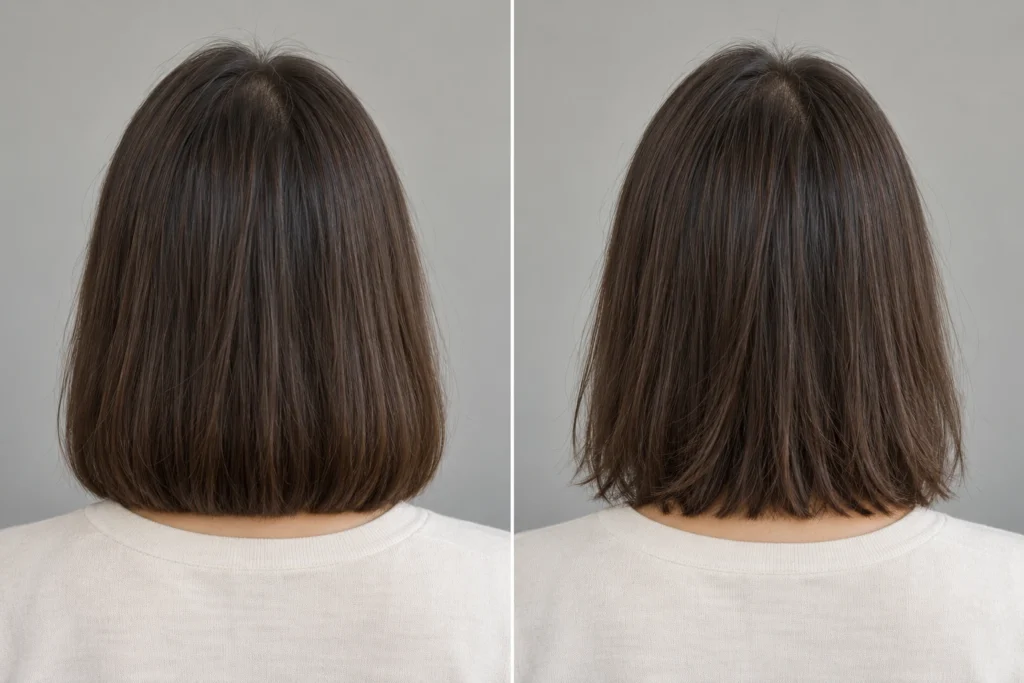
Fine hair can also be dense. If you like the ends but find the interior bulky, discuss selective shaping inside the cut. Sam Villa’s perimeter-preserving layering guidance demonstrates that movement and a substantial edge need not be mutually exclusive.
Coarser strands or higher density
If the cut feels bulky in specific areas, identify them: behind the ears, around the sides, or through the lower back. Ask what targeted shaping would change. An alternative is keeping more length and weight if you prefer the way it settles.
Avoid requesting “thin it out” without agreeing on the intended result. Layers, razors, and thinning shears are techniques to discuss, rather than universal requirements or automatic mistakes. Ask why a method suits your hair’s condition and desired finish.
A photograph cannot reliably establish strand diameter or count hairs. A fuller-looking edge is a visual effect of the cut; it does not mean follicle density has increased.
Balance layers, bangs, length, and upkeep
Describe the job each change needs to do. “Keep my hair out of my eyes” may lead to a different front section than “give me a short fringe.”
| Your priority | A useful starting point | The tradeoff to check |
|---|---|---|
| More continuous-looking ends | A substantial perimeter | Less separation through the outline |
| More movement inside the cut | Selective layers | Shorter pieces may need arranging |
| An easy ponytail or puff | Enough length in the shortest sections | Some front layers or bangs may stay loose |
| Less daily styling | A shape that follows your usual fall | A precise outline may still need regular trims |
| More time between appointments | Softer edges and longer front pieces | The shape will change as it grows |
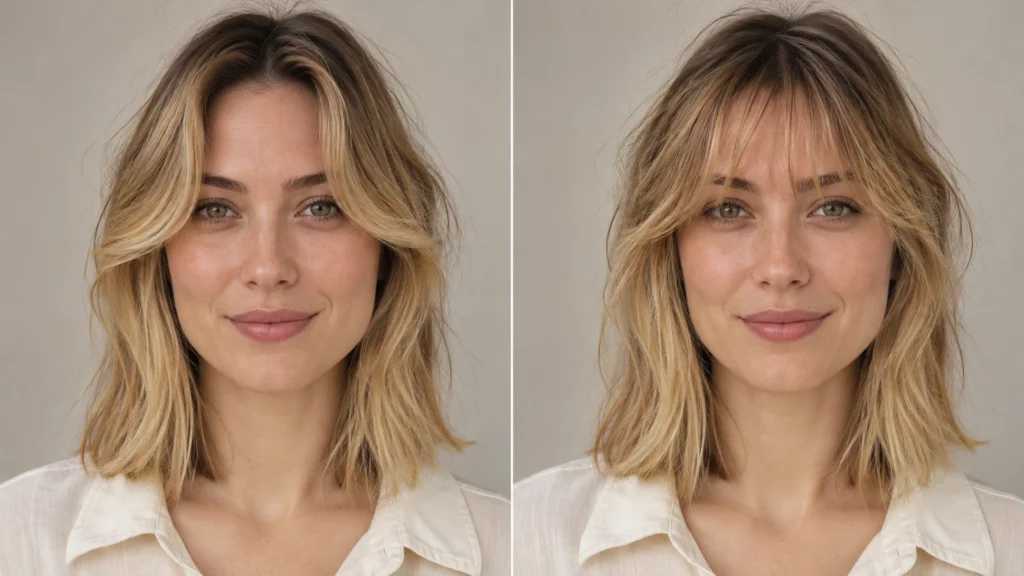
For bangs, consider your hairline, cowlicks, preferred part, and tolerance for refreshing the front. A longer fringe offers more room to sweep it aside, although cheek- or jaw-length pieces may still escape a ponytail. Before committing, look through how to style curtain bangs at home to see whether the routine suits you.

If tying your hair back matters, demonstrate the fastening position during the consultation. “Shoulder length” alone does not guarantee every layer will reach. These easy hairstyles for medium-length hair show why the shortest sections and fastening height matter.
Budget for both appointments and home upkeep. Ask for the likely reshaping interval, the total service price, and any separate bang or neckline appointments. There is no single trim schedule that suits every cut.
Take a clear brief to the salon
Choose a stylist whose work includes hair with a similar pattern, density, and preferred finish. Ask to see side and back views as well as polished front-facing photos.

Bring two or three references and explain the detail you like in each: the lower edge, crown shape, fringe, or length. Include one feature you do not want. Face shape can be part of an aesthetic preference, but it does not need to become a list of features to hide.
Use this short checklist before agreeing to the cut:
- Show how your hair looks in your usual routine.
- Describe your styling time, tools, budget, and previous haircut difficulties.
- Agree on the finished dry length and the shortest layer.
- Demonstrate any tie-back, ear-tucking, or fringe requirements.
- Ask which effects in the reference need styling or added hair.
- Confirm how the stylist will check the back, sides, and dry outline.
You could say: “I usually air-dry my hair and need enough length to tie it back. Can you show me where the shortest layer will sit once it is dry?”
Discuss wet versus dry cutting
Dry cutting lets a stylist observe where hair falls in that dry finish. Wet cutting can help establish the structure of a cut, and some services combine wet cutting with dry refinement. PATTERN’s explanation of curly cutting methods discusses both approaches and why your wearing routine matters.
Ask which method the stylist recommends for your result and why. If you alternate between curls and straight styling, say so. Follow the salon’s arrival instructions, and clarify them beforehand if you are unsure whether to arrive with your hair styled or stretched.
If you notice sudden heavy shedding, patches of loss, or scalp pain, seek a dermatologist’s assessment rather than expecting a haircut to resolve the cause. The AAD describes hair-loss warning signs and explains how dermatologists distinguish shedding from hair loss.
Frequently asked questions
Do I need to know my numbered curl type before booking?
No. Numbers and letters can provide shorthand, but they do not describe density, strand thickness, growth direction, or styling habits. Photos of your own hair and a clear account of your routine are more useful than forcing mixed patterns into one label.
Can fine curly hair have layers?
Yes. The decision is where to place them and how much hair to remove. Ask what will happen to the lower outline, especially if you already find the ends too separated. A few longer layers are one option to discuss.
Is short hair always easier to maintain?
No. It may take less time to handle, but a precise crop, taper, or fringe can need frequent reshaping. A longer cut that gathers comfortably may be easier for someone who prefers quick tied-back styles.
Will cutting my hair make it curlier?
A cut can change how existing bends and curls sit by changing length and weight. It cannot guarantee a new curl pattern. Ask the stylist to distinguish changes in shape from effects created by products, diffusing, or curling tools.
Can I choose a cut if different parts of my hair have different textures?
Yes. Show the differences before the hair is manipulated into a uniform finish. Ask how the stylist will balance the silhouette while allowing those sections to behave differently, particularly around the fringe and crown.
What if I like the reference but cannot manage its styling routine?
Identify the part you want to keep. You might retain the overall length or outline while choosing fewer layers or a longer fringe. Ask to see the proposed cut in a finish you can realistically recreate.
Before booking, take three photos of your hair as you normally wear it and write down your two most important requirements. Bring those alongside the inspiration, then agree on the dry length and shortest layer before the first snip.


3 thoughts on “How to Choose a Haircut for Your Hair Texture”