

By Olivia Parker
Curtain bangs can look soft and open one morning, then sit flat against your forehead the next. Before reaching for a hotter tool, check two things: whether the roots have dried in the wrong direction and whether the ends have been bent too tightly.
To style curtain bangs at home, start with a lightly damp fringe, create gentle lift with a round brush and blow-dryer, then guide each side away from your face. Let the hair cool before separating it. For a heat-free approach, use an unheated roller on slightly damp hair and leave it until the section is completely dry.
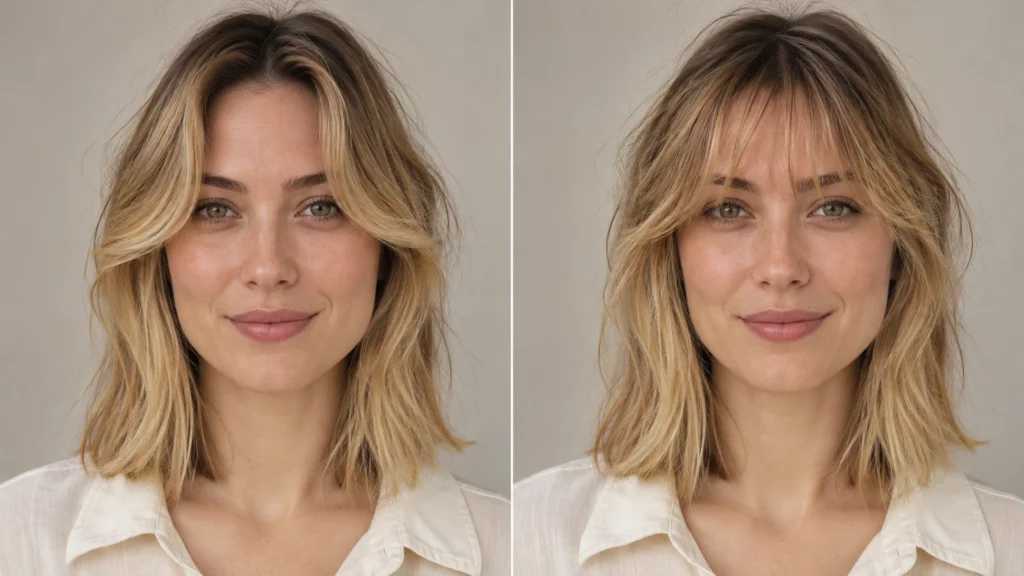
The aim is an open fringe that blends into the sides of your haircut. It can be smooth, wavy, or curly; it does not need to form two identical wings.
Choose Your Tools and Prepare Your Bangs
For a basic blow-dry, gather:
- A hair dryer with adjustable heat and a concentrator attachment.
- A round brush suited to your fringe length.
- Sectioning clips.
- A heat protectant intended for your styling method.
- A wide-tooth comb for gentle detangling.
For the heat-free version, use an unheated roller that your fringe can wrap around comfortably.
Choose the brush for the length you actually have. Shorter bangs need a barrel small enough to catch the ends without tugging. Longer, cheekbone-length pieces can sit over a larger barrel for a broader bend. If the brush produces a tight roll when you wanted a soft sweep, try a larger barrel or less rotation.
Clip the longer hair out of the way and isolate your existing fringe. Avoid pulling extra hair from far back on the crown into the section; that changes how much hair you are trying to style.
Blot excess moisture rather than rubbing. Straight hair can partially dry before gentle combing; textured hair and tight curls are generally best detangled while damp with a wide-tooth comb, as the American Academy of Dermatology explains in its hair-care guidance.
Apply heat protectant before using the dryer, following the label for amount and placement. Start with less additional styling product than you would use through your lengths.
A little mousse may help a flat fringe, while a small amount of a familiar curl styler may suit curls. Piling on several products makes it harder to see what your bangs need.
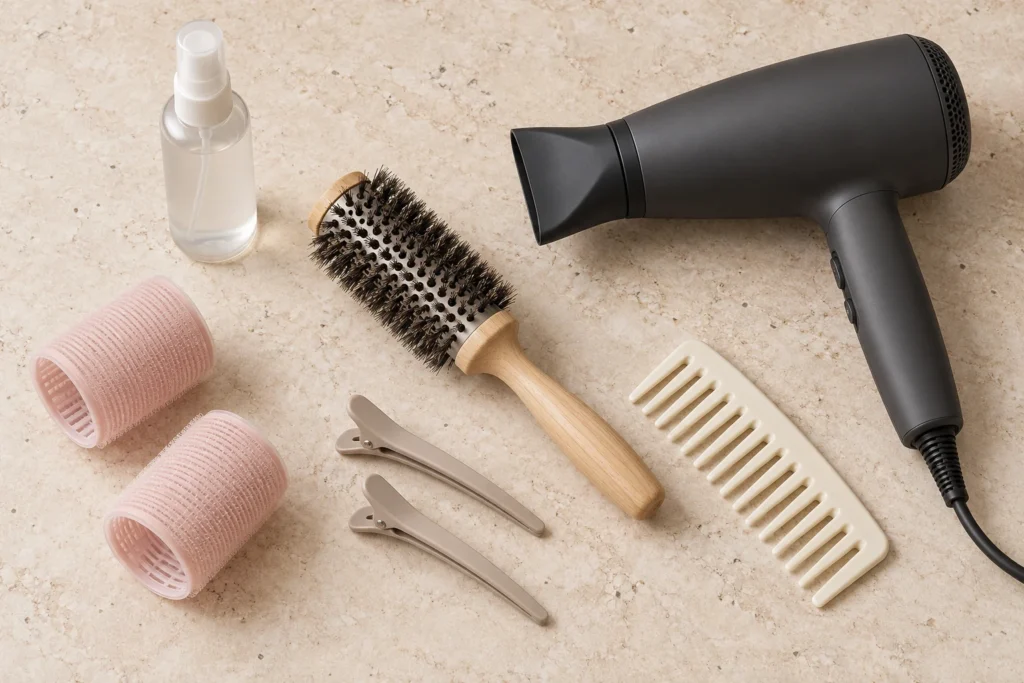
Optional tools: The Olivia Garden NanoThermic Round Thermal range offers several barrel sizes; its linked store ships within the United States only, excluding territories. For a heat-protectant option, see TRESemmé Protecting Heat Styling Spray on the brand’s U.S. website and follow the product directions.
How to Style Curtain Bangs With a Blow-Dryer
This method suits a smooth fringe with a loose outward bend. If you want to preserve natural curls, use the texture adjustments below instead of brushing them straight.
1. Start With Lightly Damp Roots
Begin while the roots are still lightly damp. If the fringe has already dried into a crease, re-dampen that section rather than repeatedly heating the same dry bend.
Clip the rest of your hair aside so you can work on the fringe without catching longer pieces.
2. Gently Direct the Roots Forward
Using your fingers or a brush appropriate for your texture, move the fringe a little to one side and then the other under gentle airflow.
Keep this brief. You are loosening an unwanted parting, not trying to erase your natural growth pattern.
If one side naturally lifts more than the other, concentrate on making it sit comfortably rather than forcing perfect symmetry.
3. Add Lift With the Round Brush
Place the round brush underneath the fringe and draw the section forward, slightly away from your forehead.
Aim the concentrator along the hair toward the ends. Keep the nozzle clear of the hair and brush, keep the dryer moving, and follow your appliance’s instructions.
You need enough gentle tension to guide the section. Pulling harder is not a substitute for dividing an awkward section into smaller pieces.
4. Give the Ends a Shallow Curve
Use a small turn of the brush rather than winding the fringe around it repeatedly.
The goal is a soft bend that opens around the face. If your bangs come out looking like a tight tube, reduce the rotation or try a larger barrel that still catches the ends.
5. Open the Curtain
Once dry, let the hair fall into your preferred center or slightly off-center part.
Work on each half separately if needed, guiding the outer lengths toward the corresponding temple. Keep the bend soft enough to blend into the side hair.
For a subtle finish, concentrate on the outer pieces rather than curling every strand into the same shape.
6. Cool, Release, and Leave It Alone
Use the dryer’s cool setting while supporting the shape, then remove the brush gently.
Separate the fringe with your fingers once it has cooled. Add a light finishing mist only if the style needs hold.
A round brush, outward shaping, and a cool finish are also the basis of Charlie Brown Hair’s curtain-bang styling guidance.
Use the lowest heat setting that works for your hair and limit repeat passes. The American Academy of Dermatology recommends lower heat and less frequent use of heated styling tools. A protectant does not make unlimited heat harmless.
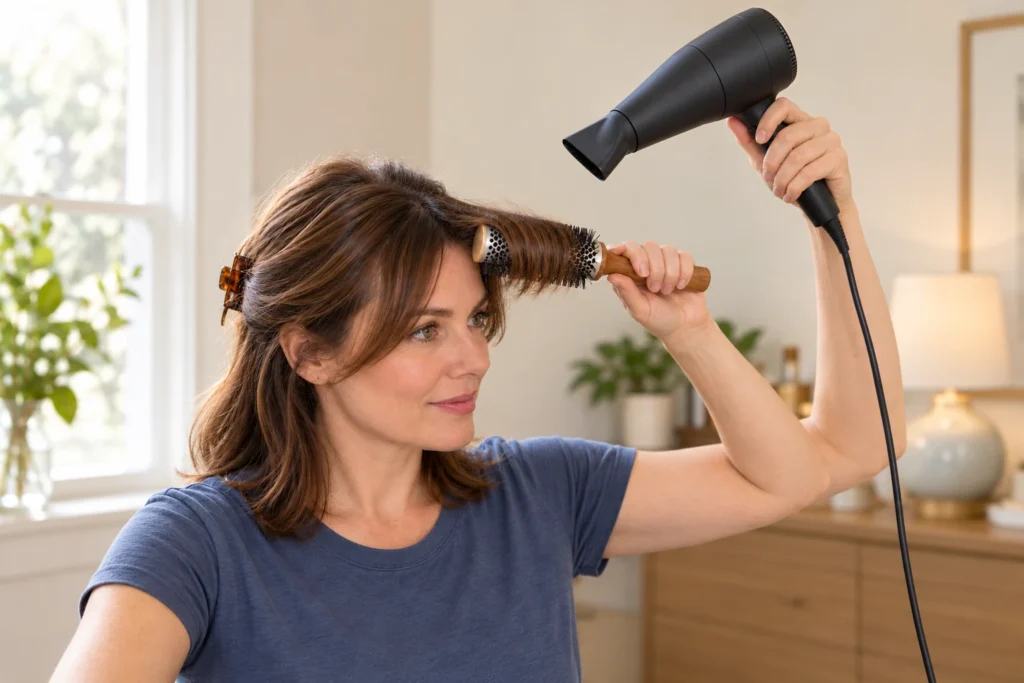
How to Style Curtain Bangs Without Heat
An unheated roller is useful when you have time to let a lightly damp section dry. It can create a rounded shape without a hot tool, although it will not give every texture the same smooth blowout finish.
Start with detangled bangs that feel slightly damp, not soaked. L’Oréal Paris’s roller guide distinguishes methods by roller type and advises against setting soaking-wet hair.
For longer curtain bangs:
- Gather the fringe. Keep the section no wider than the roller.
- Lift it upward and forward. Place the roller behind the ends, lay the tips flat against it, and roll backward toward the crown.
- Secure it gently. Avoid pulling tightly at the roots. Keep any clip away from the exposed front lengths if it leaves a dent.
- Let the section dry completely. Drying time varies with density, starting moisture, and the room. Use dryness rather than a fixed timer.
- Unroll carefully. Release any caught strands, then separate the fringe into two sides with your fingers.
If the outer pieces slip off, use a separate roller for each half, directing each section back and away from the face.
If your bangs cannot make a smooth wrap, try a smaller roller rather than forcing the ends.
Self-grip rollers can catch textured or fragile hair. A smooth roller secured with a clip may be easier to remove; stop if you feel snagging.
For a softer air-dried finish, simply guide damp bangs into place with your fingers and let their natural movement show.

Adjust the Method for Your Hair Texture and Bang Length
The same haircut can need a different routine on fine straight strands, dense waves, or springy curls. Match the method to the finish you want and the way your hair behaves when dry.
| Your Hair or Fringe | A Useful Starting Adjustment |
|---|---|
| Fine or easily flattened | Use little product, lift gently at the roots, and keep heavy finishing creams away from them. |
| Thick or dense | Divide the fringe into thinner sections so you can reach the inner hair without repeated passes over the surface. |
| Naturally wavy | Shape the front while damp, then leave some natural bend through the lengths instead of polishing every strand. |
| Curly or coily | Define the fringe in its natural pattern, allow for shrinkage, and separate curls only as much as needed. |
| Short curtain bangs | Make a small bend; a strong curl can lift the ends farther above the eyebrows than intended. |
| Long or growing-out bangs | Guide the ends into the side layers and use a broad curve rather than a tight flip. |
For Fine or Straight Hair
Start with a small amount of product and focus on the roots before adding more bend to the ends.
If your fringe looks full immediately after styling but separates into thin strands later, try simplifying the product routine. A heavy finishing cream may give you more separation than you want.
You can also reduce how often you touch the fringe once it is styled.
For Naturally Wavy Hair
Decide whether you want a smooth fringe or a finish that follows your natural wave.
For the second option, guide the damp front into position and leave some movement through the ends. Trying to remove every bend can make the fringe look disconnected from the rest of your hair.
A slightly uneven sweep can sit naturally alongside loose waves.
For Curly or Coily Hair
Arrange the damp front into the opening you prefer, apply a small amount of your usual styler, and encourage individual curl groups with your fingers.
Let them air-dry or use a diffuser on low heat and gentle airflow, following the appliance instructions. Repeated brushing after drying can disrupt the definition you just created.
Judge the fringe when it is dry. Pulling a curl straight tells you little about where it will sit after it springs back.
When discussing a cut, tell your stylist whether you usually wear your natural texture or a stretched finish. L’Oréal Paris’s curtain-bang guide also emphasizes adapting the cut for wavy and curly hair.
For Short or Growing-Out Bangs
Short curtain bangs usually need a small amount of shaping. A strong curl can lift the ends much higher than you intended.
With longer bangs, guide the ends into the surrounding layers rather than creating an isolated flip.
If you are pairing bangs with a shorter haircut, our guide to bob haircuts for different hair types can help you consider the fringe alongside the overall shape.
If holding a dryer and brush overhead is tiring, sit comfortably and style smaller sections with breaks, or choose a roller method. Choose the routine you can repeat comfortably.

Fix Common Problems and Refresh Curtain Bangs
Before adding heat or another product, identify whether the problem starts at the roots, through the bend, or at the ends.
Change one thing at a time so you can see what helps.
| What You See | What to Try |
|---|---|
| Flat roots with curled ends | Re-dampen the roots and add gentle lift there. More curling at the ends will not address the flat base. |
| A rounded “sausage” shape | Use a larger brush or roller, reduce the turn, and separate the sides after cooling. |
| One side pointing inward | Reset that side alone, then guide its outer length toward the temple. |
| A cowlick creating a wide gap | Lightly dampen the roots and direct them side to side before choosing the part. Accept a softer or offset opening if it sits more comfortably. |
| A greasy or stringy fringe | Wash just the front section when needed and reconsider how much leave-in product reaches the roots. |
| Bangs changing shape in humidity | Try a familiar humidity-control styler sparingly, or wear the natural wave rather than repeatedly straightening it. |
Work With a Cowlick
A cowlick is a growth pattern, so styling can manage its appearance without permanently changing it.
Start with damp roots and gently direct the section from side to side before settling on the opening. A slightly off-center part may be easier to maintain than a perfectly central one.
If a section always springs upward, ask a stylist to assess the length and weight before attempting to cut it yourself.
Refresh Only the Front
On a morning when the rest of your hair looks fine, clip the lengths back and lightly wet the fringe, including the roots where it has creased.
If it feels oily or coated, a small fringe-only wash may work better than adding water over buildup.
For a heat-free reset, finger-shape or use a roller. If choosing the dryer, follow your heat-protectant directions and use a brief, gentle restyle.
Stop once the section is dry and shaped.
Dry shampoo is optional for an oily root, not a replacement for washing. Use it sparingly according to the label, let it settle, and keep it out of your eyes. Adding more powder to a product-heavy fringe can leave it looking dull.
Know When the Cut Needs Attention
Styling cannot create missing length.
If the shortest pieces will not reach the brush, or the fringe consistently falls into your eyes, book a shape adjustment rather than increasing the heat.
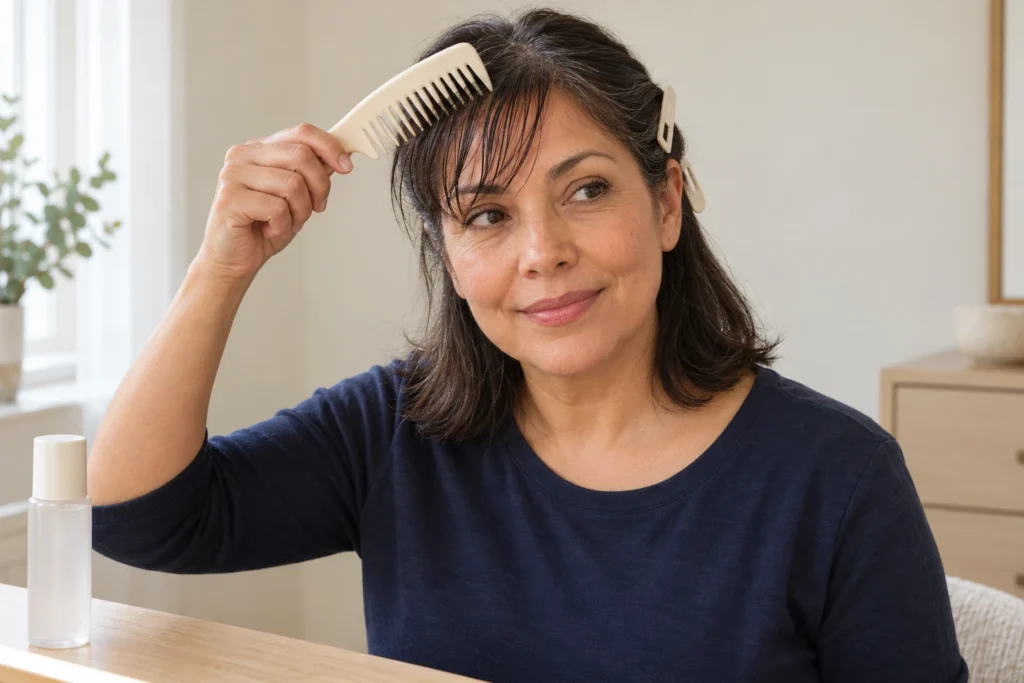
Bring a photo of your bangs on an ordinary day and explain how much styling you want to do. A useful haircut should account for your natural texture, growth pattern, and preferred routine.
Frequently Asked Questions
Should You Style Curtain Bangs Wet or Dry?
For the blow-dryer method, start with lightly damp hair and controllable roots.
For unheated rollers, use slightly damp hair that can dry fully in the set.
A conventional flat iron belongs on completely dry hair; follow the tool’s instructions.
Do You Roll Curtain Bangs Toward or Away From Your Face?
For the lifted, backward sweep described here, roll the front section back toward the crown, away from the face.
After removing the roller, separate the fringe and guide each side outward. Keep the ends smooth during wrapping to avoid a kink.
Can You Style Curtain Bangs With a Straightener?
Yes, on completely dry hair.
Use a suitable low setting and make a shallow curve outward through each side’s mid-lengths and ends. Avoid clamping close to the forehead or pausing on one spot.
Skip this method when the dryer or rollers already give you the shape you want.
Do Curtain Bangs Need a Middle Part?
No. A middle part creates a balanced opening, but a slightly off-center part can work with your hairline and preferences.
The sides do not have to mirror each other precisely.
How Do You Keep Curtain Bangs in Place Overnight?
Let them dry fully before bed and avoid fastening a tight clip across the front where it can leave a crease.
A loose, comfortable arrangement is more practical than trying to preserve a rigid shape. Expect to make a small adjustment in the morning.
Do You Have to Style Curtain Bangs Every Day?
Only if they need it and you want that finish.
Some mornings a finger adjustment is enough; others call for a targeted damp reset. Use heat selectively rather than automatically repeating a full routine.
Start with the simplest method that suits your texture: gentle brush shaping for a smooth sweep, a roller when you have drying time, or finger styling for natural movement.
Once you like the result, stop working the fringe. Soft curtain bangs need enough shape to open around the face and enough flexibility to move.


2 thoughts on “How to Style Curtain Bangs at Home: A Practical Guide”