By Olivia Parker
A pair of jeans can button comfortably and still pull across the seat, sit lower than expected, or finish at the wrong point on your shoe. The size label cannot explain all of that. Learning how to measure jeans gives you a more useful reference: the dimensions of a pair whose fit you already understand.
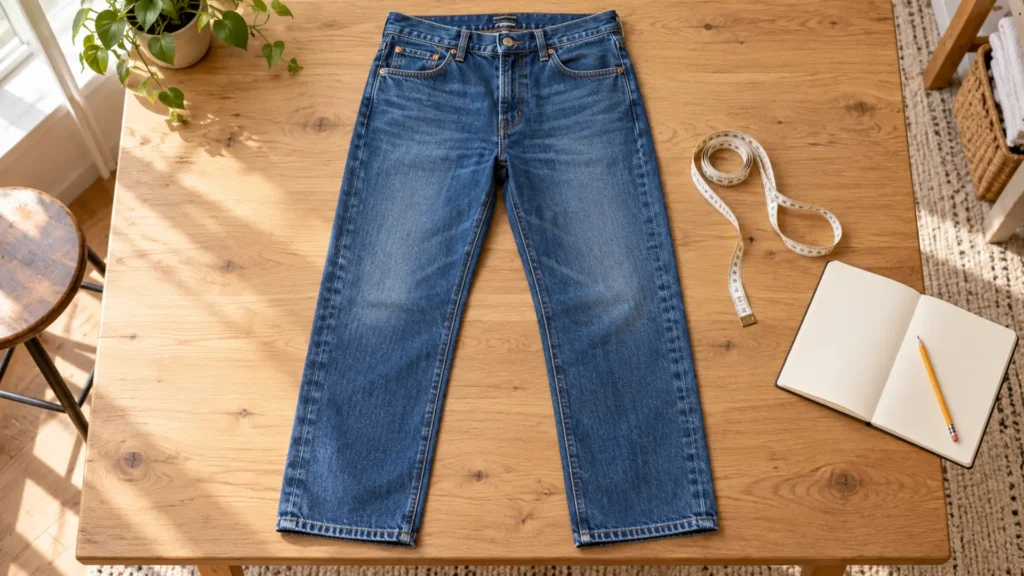
The quick method: Fasten the jeans and lay them on a flat surface. Measure the waistband across, the front and back rises from the crotch junction to the waistband, the hip width at a recorded position, and the inseam from crotch to hem. Double flat waist and hip widths only when you need an approximate full circumference. Keep body measurements in a separate record.
The distinction matters whether you are buying women’s or men’s jeans, comparing secondhand listings, or deciding what to alter. Use the steps below, then save your measurements in the inches/cm worksheet.
Before You Begin: Separate Body Measurements From Garment Measurements
Body measurements describe you. Garment measurements describe the jeans. A retailer’s size chart might show either, so check its heading and measurement diagram before comparing numbers.
| Measurement | Taken on your body | Taken on the jeans |
|---|---|---|
| Waist | Around the waist location specified by the brand | Across the fastened waistband using the retailer’s method |
| Hips or seat | Around the fullest part of the hips and buttocks | Across the seat at a specified distance below the waistband |
| Rise | A body crotch measurement, when specifically requested | Crotch seam junction to the top of the front or back waistband |
| Inseam | Inside leg to the endpoint specified by the size guide | Inside leg seam from crotch junction to finished hem |
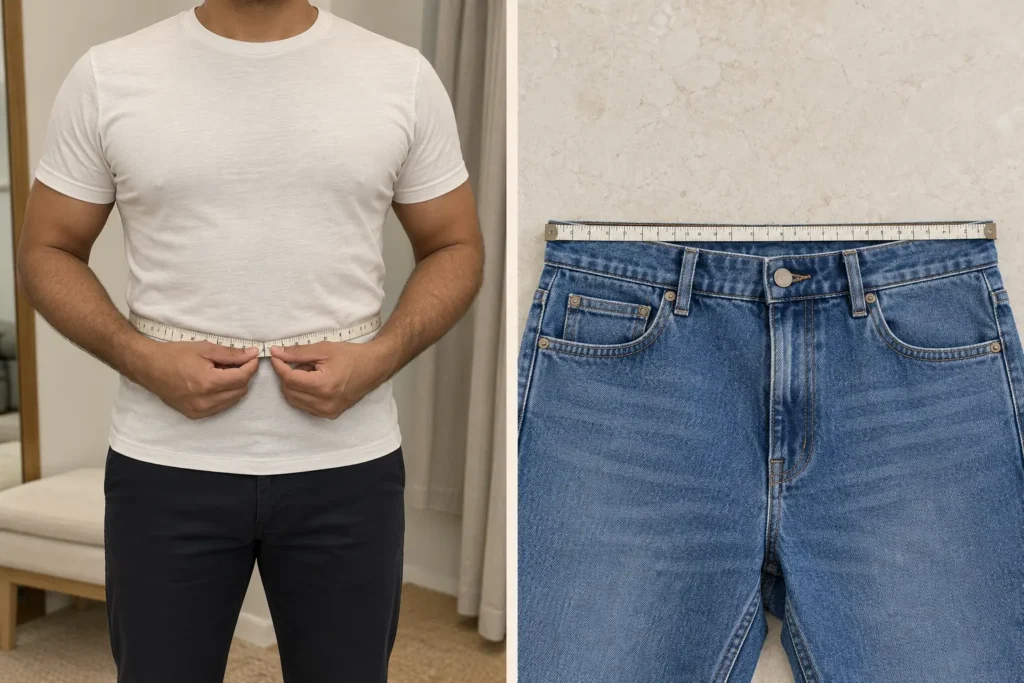
The space built into a garment for movement is called ease. Stretch, the cut, and where the waistband sits also affect the relationship between body and garment measurements. There is no single number to add to every body waist measurement to find the right jeans.
Gather a flexible tape, a flat table or floor, a mirror, and a way to record the results. Check that the tape starts at zero rather than at the end of an unmarked tab. Choose reference jeans that fit as you want the next pair to fit, preferably in a similar silhouette and fabric.
Note whether those jeans are freshly washed and completely dry or have been worn since washing. Measure twice without deliberately stretching the fabric. If the results differ, reset the jeans and check your tape placement.
Shop the measuring tool: The SINGER ProSeries 96-inch retractable tape measure is one verified option with inch and centimeter markings. Any flexible tape long enough for your measurements can serve the same purpose; this product is not identified as the tape in the illustrations.
How to Measure Your Body for Jeans
Take body measurements over underwear or a thin, close-fitting layer. Keep the tape in contact with your body without digging in, and breathe normally.
Natural waist and waistband position
Find your natural waist between your lower ribs and the top of your hips. It is often the narrowest part of the torso, but a strong inward curve is not necessary. Check the brand’s diagram rather than using your belly button as a universal landmark.
Wrap the tape horizontally around that level and record the full circumference. If you prefer jeans that sit lower, take a second circumference where their waistband would sit. Label it preferred waistband position so you do not substitute it for a chart requesting natural waist.
Ariat’s body-measurement guide makes the useful distinction that different rises sit at different places on the torso. A larger circumference lower down does not automatically mean you need a larger labeled size.
Full hips and seat
With your feet comfortably close together, pass the tape around the fullest part of your hips and buttocks. Check the side and back in a mirror: the tape should stay level rather than climbing over the seat or dipping at the front.
Do not assume your fullest hip is a fixed distance below your waist. Levi’s body-measurement instructions also place the hip tape around the fullest area, parallel to the floor.

Body inside leg
Begin at the top of the inside leg at the crotch and measure down the inner leg to the brand’s stated endpoint. Ask someone to help if bending makes the tape move.
A body inside-leg measurement to the ankle and one to the floor are different records. For example, Levi’s describes an ankle endpoint, while Lee’s women’s size guide specifies the floor without shoes.
Neither number is automatically the finished inseam you will want in every cut. Keep the endpoint in your notes.
How to Measure the Waist of Jeans Laid Flat
For a common straight-across waistband measurement:
- Close the button and zipper or button fly. Empty the pockets and remove the belt.
- Lay the jeans face up and smooth the waistband. Bring the front and back top edges together as closely as the construction allows, following the seller’s diagram.
- Place the tape at one outer waistband edge and measure straight across to the opposite edge.
- Record that number as flat waist width.
- If the chart gives a full waistband circumference using this method, multiply the width by two.
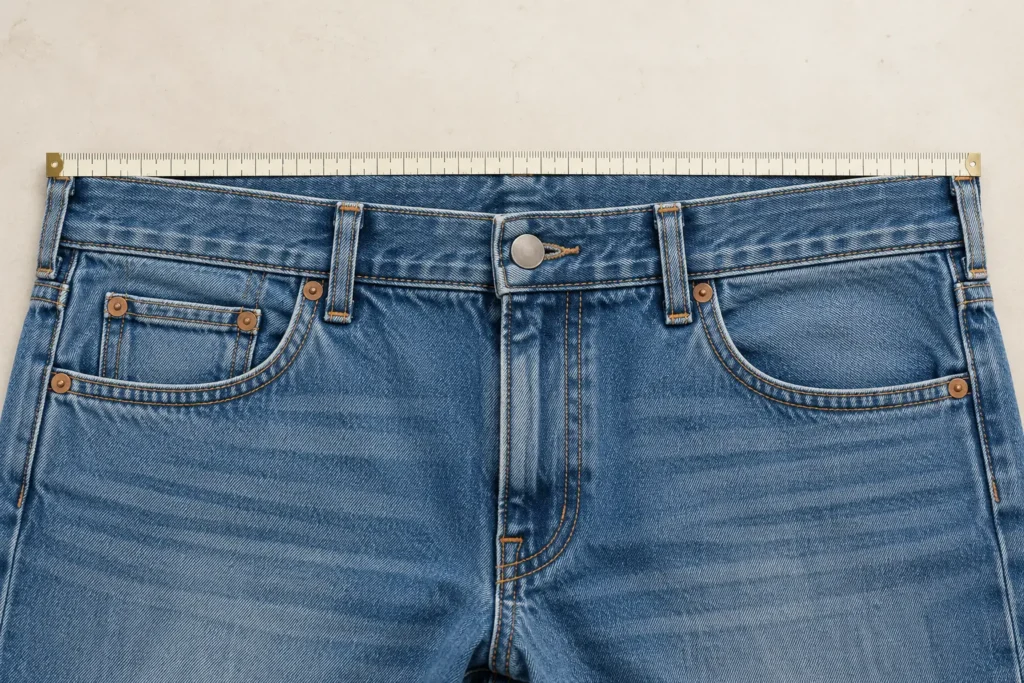
Example: A 16-inch flat width gives an approximate 32-inch garment circumference: 16 × 2 = 32. That is a garment measurement, not proof that the jeans fit every person with a 32-inch body waist.
Blue Owl’s photographed measuring guide demonstrates an aligned-waistband method. It specifies pulling the waistband taut; other sellers report relaxed measurements. Reproduce the method used by the listing you are checking rather than comparing a stretched reading with a relaxed one.
What if the waistband curves?
A contoured waistband may resist lying in one straight line. Measuring along its curved edge with a flexible tape can produce a different result from measuring straight across. Record which method you used and ask the seller how theirs was taken.
Do not confuse a half-width listing with a full circumference. A quarter-inch difference across the flat waistband becomes half an inch after doubling.
How to Measure Front Rise and Back Rise
Rise describes the distance between the crotch junction and the waistband. It helps explain where jeans sit and how their upper section fits.
Front rise
Lay the jeans face up. Locate the crotch junction where the inseams meet the rise seams. Measure from that junction to the top edge of the front waistband, including the waistband unless the retailer says otherwise.
Keep the tape on the center-front measurement path. Some guides specify a straight measurement; others follow the seam’s contour. Match the method rather than taking a diagonal shortcut.
Back rise
Turn the jeans over and measure from the same crotch junction to the top of the center-back waistband. Record it separately; it is not interchangeable with front rise.
The Naked & Famous Denim measuring guide shows separate front- and back-rise measurements, including their waistband endpoints.
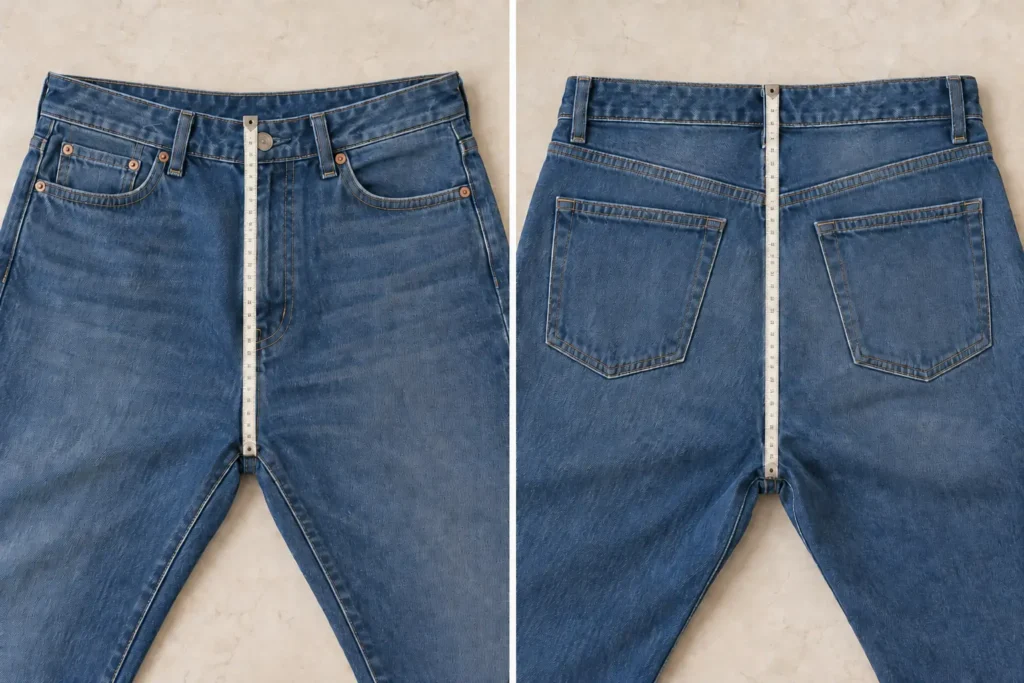
Compare both rises with a pair you like. A waistband that slips when you sit or a crotch that feels restrictive needs more investigation than waist width alone. These symptoms can also involve seat room and the shape of the crotch seam, so one rise number cannot diagnose every fit problem.
High-, mid-, and low-rise descriptions are useful starting points, but their dimensions vary. Our petite-versus-short jeans guide explains why a shorter inseam does not necessarily mean a different rise or proportion through the upper jeans.
How to Measure Hips on Jeans
The hip measurement needs a location as well as a number.
- Check whether the retailer specifies a distance below the waistband.
- With the jeans fastened and laid flat, locate that same level on your reference pair.
- Smooth the seat without pulling it wider. Measure horizontally from one outer edge to the other, following the retailer’s diagram.
- Record the flat hip width and the distance below the waistband.
- Double the width only if you need an approximate full garment circumference using that method.
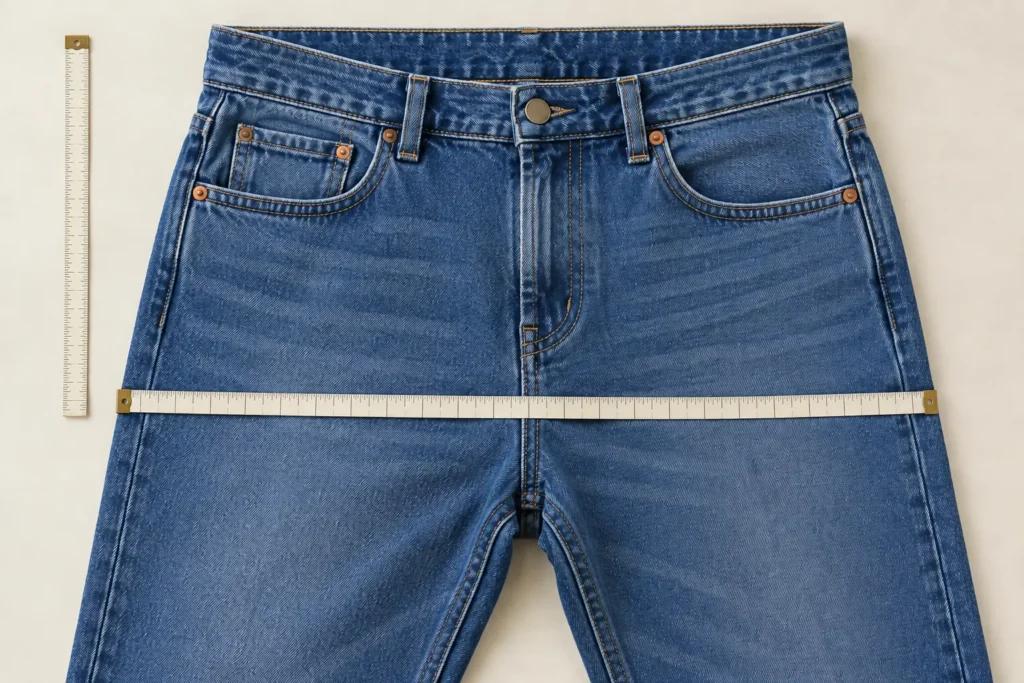
There is no universal measuring depth. For example, Weirloom measures its jeans’ hip width 11 cm below the waistband. That is its own reference point, not a rule to apply to every brand.
If no method is supplied, measure across the widest seat area and record exactly where you measured. Ask the seller for the same measurement before treating the two numbers as comparable.
A pair can fit at the waist while remaining too close through the seat. If this is a recurring problem, compare cuts with a different waist-to-hip relationship. The guide to jeans for different body proportions can help you choose which shapes to investigate after you have recorded your measurements.
How to Measure the Inseam of Jeans
The inseam is the inside leg seam from the crotch junction to the bottom of the hem. It is not the measurement down the outside of the jeans.
- Lay one leg flat with the inside seam accessible. Fold the other leg aside if necessary.
- Place the tape’s zero mark at the crotch seam junction.
- Follow the inside seam to the finished bottom edge, keeping the tape smooth without stretching the leg.
- Record the length. Check the other leg if the jeans are secondhand or have been altered.

Levi’s guide to measuring jeans also uses the garment’s crotch-to-hem measurement for inseam.
Measure to the actual bottom edge, not the stitching line above it. Unroll a temporary cuff if you want the jeans’ full length; record the cuffed wearing length separately. If the hem is frayed, note whether you measured to the solid fabric or the longest fringe.
Choose a reference pair with a similar rise and leg shape. Jeans that sit lower at the crotch can place the hem differently even when the measured inseam matches.
For ankle-length denim, compare where the hem meets your usual footwear. Our ankle boots and jeans guide explains the space a boot shaft needs, while the wide-leg jeans guide covers longer hems and different shoe shapes. Keep separate preferred lengths if you wear the same silhouette with flats and heels.
Extra Measurements That Help Explain Fit
Waist, rise, hips, and inseam cover the main comparisons. Add these when the leg shape is important:
- Thigh width: Measure across one leg at the crotch level or the specified distance below it. Record the location and keep the reading as a flat width unless the chart requests otherwise.
- Knee width: Measure at the retailer’s stated distance down the leg, then across it. A width without its vertical position cannot tell you where a taper or flare begins.
- Leg opening: Measure straight across the flattened hem. This can help you compare room around a boot or the shape of a cuff.
- Outseam: Measure along the outer leg from waistband top to hem. Keep it separate from inseam.
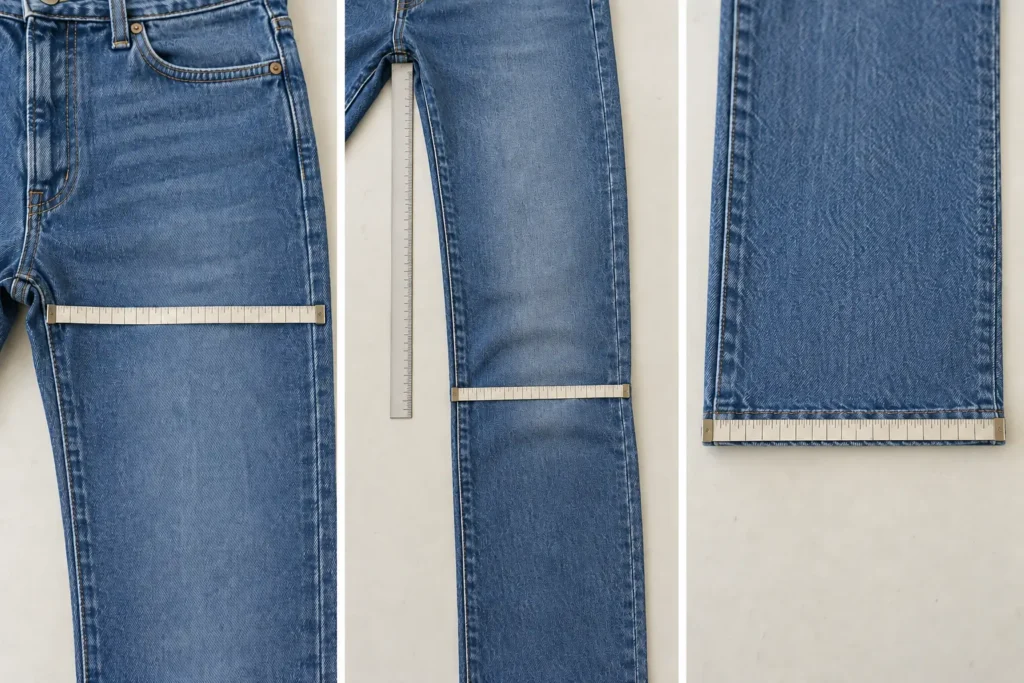
Do not calculate rise by subtracting inseam from outseam. The measurements follow different paths, so that subtraction is not a dependable substitute for measuring the rise itself.
Your Jeans Measurement Worksheet: Inches and Centimeters

Copy or print these tables and complete one garment record for each pair. Leave rise in the garment table; do not substitute an unrelated body crotch measurement.
Date: __________
Body measuring layer: __________
A. Body measurements
| Body measurement | Inches | Centimeters | Location or endpoint |
|---|---|---|---|
| Natural waist circumference | ______ | ______ | Brand’s natural-waist position |
| Preferred waistband circumference | ______ | ______ | Position: ______ |
| Full hip/seat circumference | ______ | ______ | Fullest hips and buttocks |
| Body inside leg, if required | ______ | ______ | Endpoint/shoes: ______ |
B. Garment measurements
Brand/style: __________
Tagged size: __________
Fabric/stretch description: __________
Condition: washed and dry / worn since washing
Alterations or cuffs: __________
| Jeans measurement | Inches | Centimeters | Method note |
|---|---|---|---|
| Flat waist width | ______ | ______ | Relaxed/taut; straight/curved: ______ |
| Approximate full waist, if flat width × 2 applies | ______ | ______ | Keep separate from body waist |
| Front rise | ______ | ______ | Waistband included? Path? ______ |
| Back rise | ______ | ______ | Waistband included? Path? ______ |
| Hip measuring depth below waistband | ______ | ______ | Reference point: ______ |
| Flat hip width at that depth | ______ | ______ | Width, not circumference |
| Approximate full hip, if flat width × 2 applies | ______ | ______ | Same level and method |
| Inseam: left/right | ______ / ______ | ______ / ______ | Crotch to finished hem |
| Flat thigh width, optional | ______ | ______ | Distance below crotch: ______ |
| Flat knee width, optional | ______ | ______ | Distance down leg: ______ |
| Flat leg-opening width, optional | ______ | ______ | Across flattened hem |
| Outseam, optional | ______ | ______ | Waistband top to hem |
Fit notes:
Standing __________
Sitting __________
Walking __________
Shoes and preferred hem position: __________
Seller’s method or chart link: __________
Convert the units without changing the measurement
NIST’s conversion tables give 1 inch = 2.54 centimeters.
- Inches to centimeters: multiply by 2.54.
- Centimeters to inches: divide by 2.54.
- Convert a flat width as a flat width. Doubling is a separate step.
These are calculation examples, not measurements from a tested garment:
| Example | Inches | Centimeters |
|---|---|---|
| Flat waist width | 16 | 40.64 |
| Approximate doubled waist | 32 | 81.28 |
| Front rise | 11 | 27.94 |
| Flat hip width | 20.5 | 52.07 |
| Approximate doubled hip | 41 | 104.14 |
| Inseam | 30.5 | 77.47 |
Keep the original reading, then round only as needed for the chart. Converted decimal places do not make a tape measurement more precise.
How to Use Your Measurements When Shopping
Start by asking what the size chart measures. Compare your body with a body chart, and your reference jeans with a garment chart taken using the same method.
Then check the whole fit. A close waist match does not cancel out a smaller hip width or a different rise. If your natural waist and hips point toward different sizes, follow the brand’s fit advice and consider another cut rather than assuming one measurement should always win.
Read the fabric and wash information for that exact product. Stretch and rigid denim do not call for one universal sizing allowance, and shrinkage instructions should come from the maker. Do not buy an uncomfortable pair on the assumption that wear will fix it.
For a secondhand listing, request current measurements and a clear photo showing the tape’s start and endpoint. Ask about hemming, waistband alterations, and the condition in which the jeans were measured. Tagged size alone is a weak comparison across unfamiliar brands and eras.
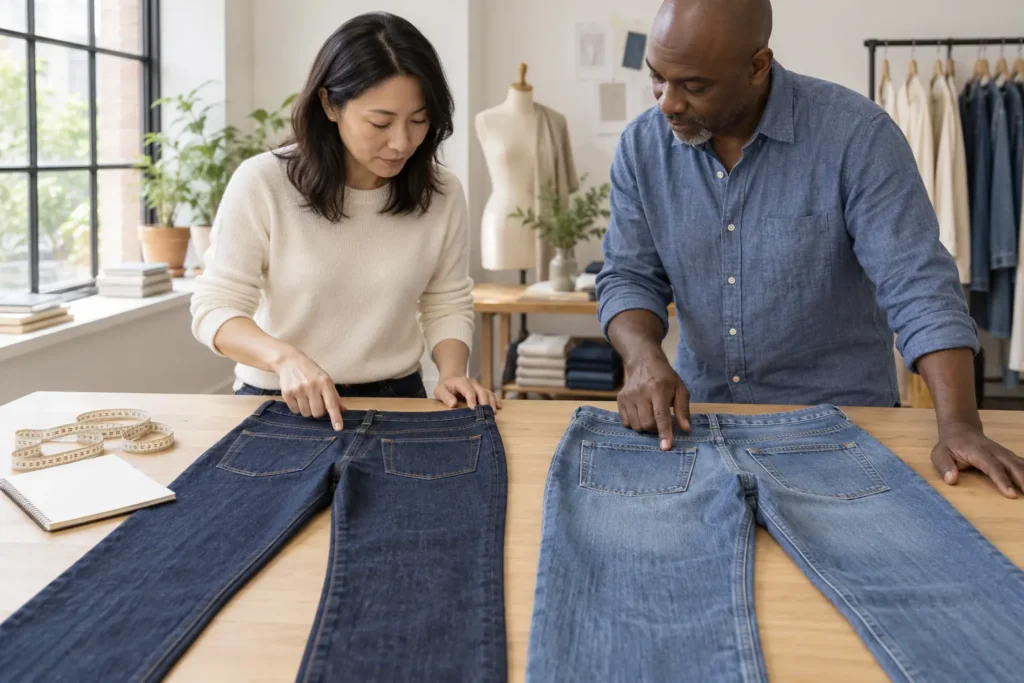
Before paying, check the return terms. When the jeans arrive, try them sitting, walking, and bending as you normally would, with the shoes you intend to wear. The worksheet narrows the choices; the final decision still includes how the garment moves on you.
Frequently Asked Questions
Do you double the waist measurement on jeans?
Double a flat waistband width when the chart uses that method to estimate full circumference. Do not double a measurement already taken around your body or around the complete waistband. Keep relaxed and stretched readings separate.
Is a size 28 the same as a 28-inch measured waistband?
Not necessarily. Treat 28 as the brand’s size label until its chart explains the relationship. Check the actual garment measurement and where that style is designed to sit.
Should you measure jeans while wearing them?
Measure your body for a body chart and lay jeans flat for a garment chart. Wearing the jeans is useful for checking waistband position, comfort, and hem length, but it does not reproduce a flat measurement method.
Can you measure without a flexible tape?
Use a nonstretch cord or narrow strip of paper, mark the start and endpoint, and lay it against a ruler. Avoid elastic string. A flexible tape is easier to keep level around the body and to follow along seams.
Are men’s and women’s jeans measured differently?
The basic garment landmarks are the same. Brands may use different hip depths, measurement paths, and chart conventions, so use the instructions for the particular product rather than relying on the department label.
Keep the finished worksheet with the brand, style, and fabric details. The next time you compare jeans, those notes will let you ask a precise question: how does this pair differ from one whose fit you already know?