

By Olivia Parker
You can shorten jeans until the hem lands perfectly and still find that something feels wrong. The waistband may sit too high, a bootcut may widen too far down your leg, or the back pockets may land lower than you prefer.
That is the useful question behind petite vs. short jeans: does the garment need less length at the bottom, or different proportions above it?
Quick answer: Short jeans usually offer a shorter inseam within a standard fit. Petite jeans may also adjust the rise and the placement of leg shaping and other details. The exact changes depend on the brand and style. If your jeans fit comfortably everywhere except the hem, start with short lengths or hemming. If the rise or leg shaping also feels misplaced, compare a petite version.
Evidence note: This guide uses official brand guidance and manufacturer-published specifications. The numerical comparison below is not a hands-on garment test. Unpublished knee and pocket measurements are left unquantified.
What “Petite” and “Short” Actually Mean
Think of “short” as a length option and “petite” as a possible change to the garment’s pattern, then check whether the retailer uses those terms that way.
Madewell distinguishes its short fit, which retains the standard fit with a shorter inseam, from petite, which also has an adjusted rise. That distinction is useful, but it should not become a universal promise about every label.
Petite also does not mean a small waist or narrow hips. Height and horizontal size describe different things. Anthropologie’s petite fit guide explains that proportions can make petite clothing useful even for someone above the height usually associated with the category. Its designers also describe adjusting garment details rather than simply cropping the bottom.
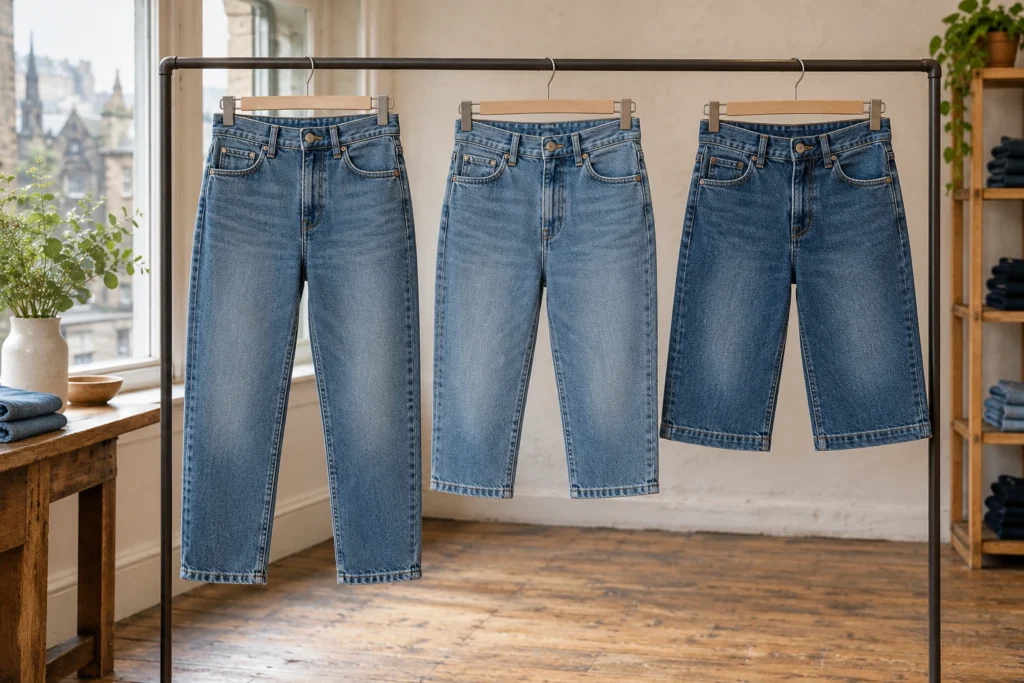
Three shopping terms deserve separate attention:
- Short: Check which inseam is offered and whether the rest of the fit changes.
- Petite: Look for an explanation of the adjusted proportions.
- Cropped or ankle: These describe an intended hem position. They do not establish that the rise or knee placement has been redesigned for a shorter frame.
A cropped regular jean can work beautifully on you. It simply needs the same fit checks as any other pair.
What One Brand’s Published Measurements Show
Two Madewell listings make the distinction concrete: The Short ’90s Jean, item OC347, and The Petite ’90s Jean, item OC346. Both pages identify a morning wash and Comfort Stretch fabric.
| Published specification | Short OC347 | Petite OC346 |
|---|---|---|
| Listed rise | 10½ in / about 26.7 cm | 10 in / 25.4 cm |
| Inseam | 29 in / about 73.7 cm | 28 in / about 71.1 cm |
| Leg opening | 17 in / about 43.2 cm | 17 in / about 43.2 cm |
| Separate back rise | Not provided | Not provided |
| Knee position and width | Not provided | Not provided |
| Pocket dimensions and placement | Not provided | Not provided |
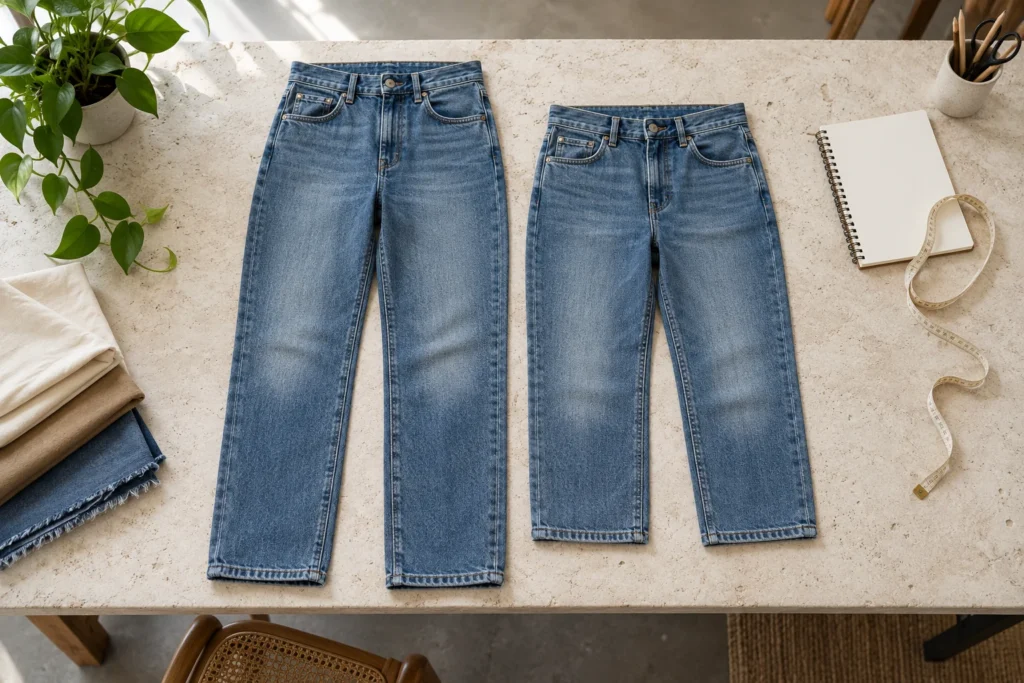
The petite listing therefore advertises a rise half an inch shorter and an inseam one inch shorter, with the same listed leg opening. These figures were checked on October 29, 2026.
There are limits to this comparison. The pages do not identify the sample size behind those measurements or provide separate front- and back-rise measuring methods. These are listing-level specifications, not measurements of two same-size garments laid side by side.
The practical lesson is to read the individual product details. A general fit description cannot tell you every measurement of a particular pair, and the label alone cannot establish what changed at the knee or pockets.
Rise: Check the Waistband and Seat Together
The rise describes the garment’s vertical fit through the crotch and waistband area. Front rise and back rise are separate measurements; a single listed rise cannot explain both.
When trying jeans on, let the waistband settle where the cut is intended to sit. Avoid pulling the jeans unusually high just to lift the hems.

Then sit down.
Does the waistband press uncomfortably toward your ribs? Does the back pull down? Is there loose fabric hanging at the crotch, or tension through the seat? These observations help you compare pairs, although no single crease proves one particular fitting problem.
A petite version with a shorter rise may help if the regular version feels too long through that area. It may feel worse if you need the original rise and only want shorter legs.
Seat room, waistband shape and the crotch curve matter alongside vertical measurements. If jeans fit your hips but gap at the waist, compare a different waist-to-hip cut as well. Our guide to jeans for different body proportions explains that separate fit decision.
Use “high-rise” and “mid-rise” to narrow the rail. Use measurements and seated comfort to choose the pair.
Knee Placement: Where the Leg Shape Changes
Knee placement matters most when the jean has noticeable shaping: a fitted knee, a bootcut that widens below it, a curved barrel leg, or a panel seam intended to sit near the joint.
Anthropologie’s denim fit guide specifically describes its petite fit as having shorter rises and inseams, with higher knee placement. That is a documented example of an adjustment beyond length, rather than something to assume about every petite jean.
In the fitting room, look at the jeans from the side with your knees relaxed. Notice where the leg narrows, curves or starts to widen. Bend your knee and walk a few steps.
If the shaping sits conspicuously below the area it was meant to follow, taking fabric off the hem will leave that shaping where it is. Compare a different pattern or a petite version whose description addresses the problem.
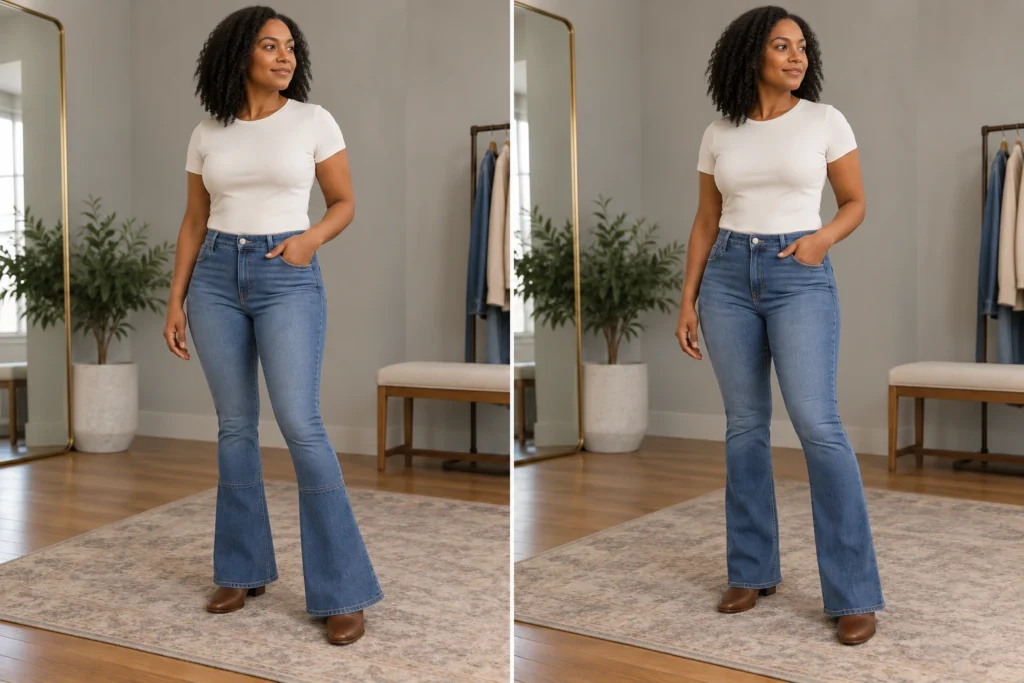
A loose straight leg may make a small placement difference less noticeable. Wide-leg jeans still need enough room through the upper leg and a comfortable rise, but they do not all have a distinct fitted knee. Once those proportions work, our wide-leg jeans styling guide covers the outfit choices.
Do not calculate knee placement as half the inseam. A leg’s midpoint and the intended shaping point are different things.
Pockets and the Back Yoke: Inspect the Details
Petite jeans can have repositioned or resized details, but there is no dependable rule that every petite pair has smaller or higher pockets.
Check the actual garment.
At the back, look at the pocket tops, their spacing and the yoke: the shaped panel between the waistband and the seat. Consider whether you like how those details sit when the waistband is in its intended position. Decorative pockets can deliberately be oversized or low, so placement is partly a design choice.
At the front, put your hand into each pocket. Check whether the opening is comfortable and whether the pocket bag folds or shows through when you sit.
For an objective comparison, measure pocket width and height, then record each pocket’s position from a stated landmark. For example, measure from the top of the center-back waistband to the upper inner corner of each back pocket.
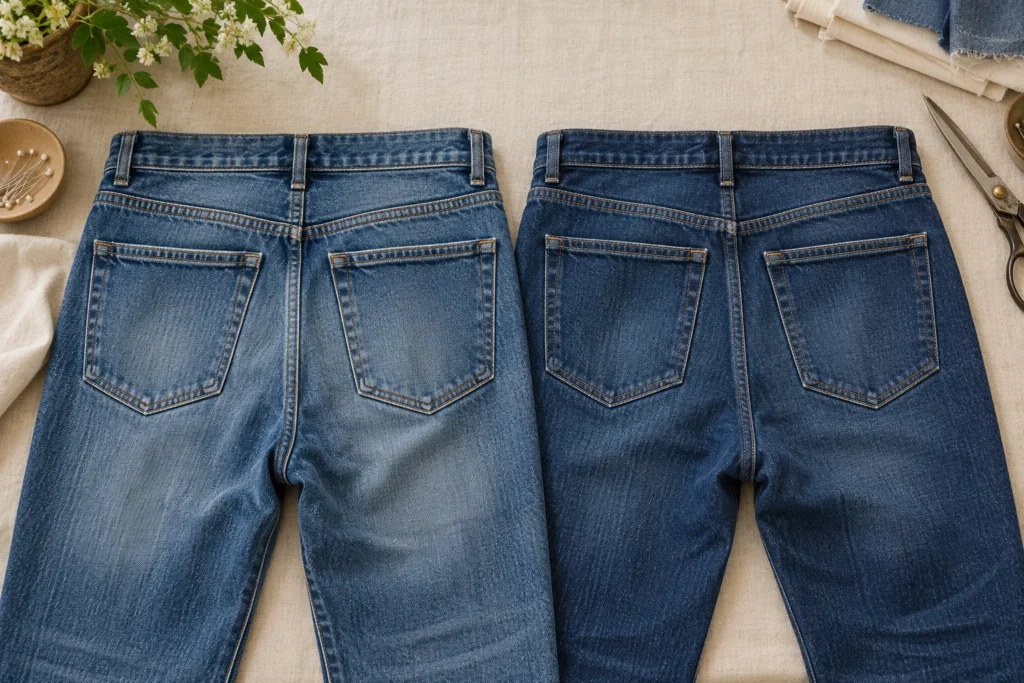
Use that same method on both pairs. Photographs taken from different angles can make pockets appear differently spaced even when the garments are similar.
A pocket that looks lower does not prove the whole rise is too long. Assess the waistband, seat and details together.
Inseam and Hemming: When Shorter Is Enough
The inseam runs from the crotch junction down the inside leg to the hem. It is a garment measurement; your height alone cannot tell you the right number.
Choose the intended finish first: cropped, ankle length or a longer hem that falls over a shoe. Then try the jeans with the shoes you expect to wear.
For straight jeans, check whether the fabric falls cleanly or catches on the shoe. For a longer wide leg or flare, check the back hem as well as the front. Our guide to wearing ankle boots with jeans explains how the boot opening affects that meeting point.
When a simple hem makes sense
Hemming is worth considering when the waistband, seat, thighs and leg shaping already work. Ask the tailor to pin the length while you wear the intended shoes.
When hemming changes the silhouette
On a flared leg, removing fabric from the bottom can remove part of the widest section. On a tapered leg, shortening can leave a wider opening at the new hem. These changes follow the shape of the existing leg.
Keeping the original hem finish does not relocate the knee shaping or rebuild the rise. If several areas need alteration, ask what the work involves before committing.
Keep stretch, wear and laundry history in mind when comparing an old favorite with new denim. Follow the garment’s care instructions, and settle your keep-or-return decision before washing a purchase.
How to Measure Two Pairs Fairly
Start with jeans you already find comfortable. Their measurements give you a more useful reference than a height-based inseam recommendation.
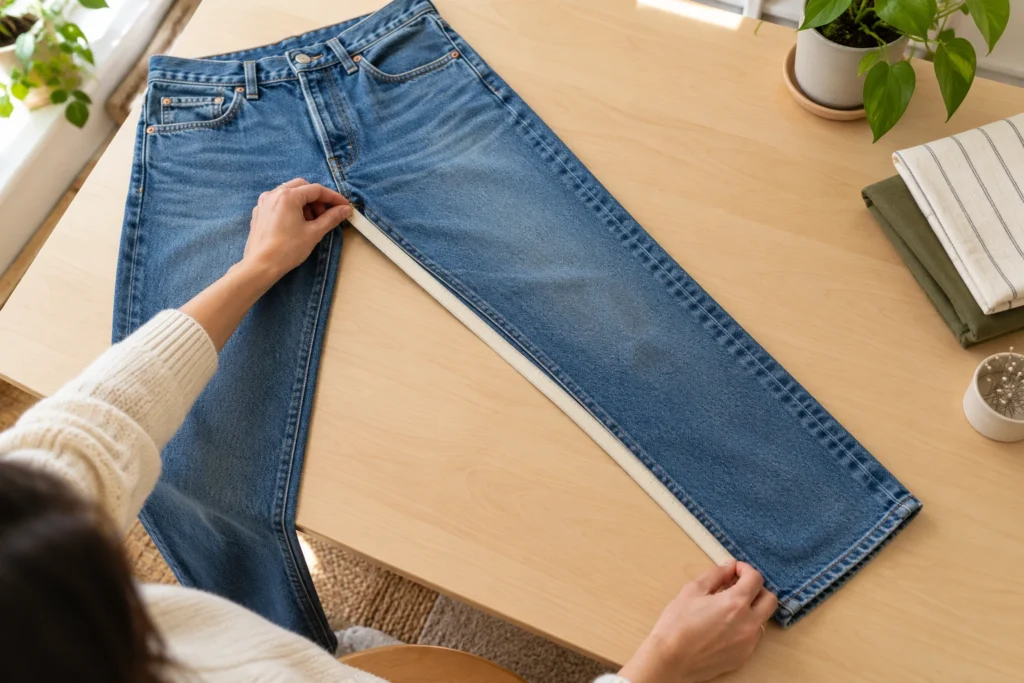
Levi’s SecondHand size guide describes measuring an existing pair flat from the crotch point down the inseam to the hem. The same principle is useful here: compare actual garments using consistent landmarks.
For a meaningful petite-versus-short comparison, choose the same style, wash, fabric and labeled waist size when available. Then measure the waist and hips too; matching labels do not establish identical dimensions.
Fasten the button and fly. Lay the jeans flat without stretching them, smooth the fabric gently, and use a flexible tape. Record inches or centimeters consistently.
| Measurement | A repeatable method |
|---|---|
| Front rise | Follow the center-front seam from the crotch junction to the top edge of the waistband; state that the waistband is included. |
| Back rise | Follow the center-back seam from the same crotch junction to the top edge of the back waistband. |
| Inseam | Follow the inside-leg seam from the crotch junction to the finished hem. |
| Waist and hip | Record the exact measuring path and hip depth below the waistband; repeat those landmarks on the second pair. |
| Knee position | Identify visible shaping or a construction landmark and record its distance below the crotch. If none is identifiable, record “not established.” |
| Knee and hem width | Measure flat across the leg at the recorded knee level and at the hem; label these as flat widths. |
| Back pockets | Record width, height and position from the same waistband landmark on each pair. |
Do not compare a flat hem width with a retailer’s leg-opening circumference without checking its method.
Record the item code, labeled size, fiber composition, wash and whether each pair is new, worn or laundered. Photograph the tape’s starting and finishing points. Repeat any measurement that looks inconsistent.
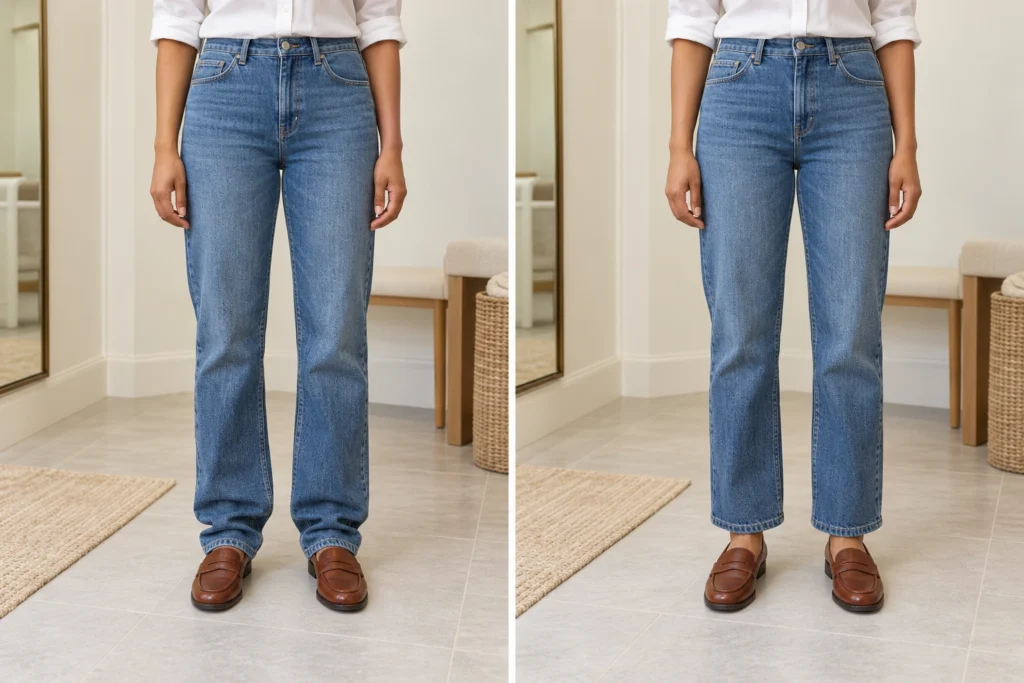
Finally, try both pairs with the same top and shoes. Use the same camera height, distance and relaxed stance for front, side and back photographs. A flat measurement can establish a difference; the try-on helps you decide whether that difference matters.
Which Fit Should You Buy?
Choose the option that addresses the fit problem you can actually identify.
| What you notice | A useful next comparison |
|---|---|
| Everything fits except excess hem length | A short length, or a tailoring quote for the existing pair |
| The regular rise feels too long and the hems are also too long | A petite version with a documented shorter rise |
| The rise works, but shaped knees sit too low | A petite or different style with better-positioned shaping |
| The waist gaps while the hips feel comfortable | A curvy or differently shaped waistband, while checking length separately |
| The jean fits well but the pockets disappoint | Another style with different pocket construction or placement |
You do not need to choose petite in every garment. A shorter person may prefer standard proportions with a short inseam; someone taller may find a particular petite bottom works better.

Shop the inspiration
The two official Madewell pages below provide a useful starting point for comparing published rise and inseam figures. They are product references, not hands-on recommendations or exact matches for the illustrative images.
Compare The Short ’90s Jean at Madewell →
Compare The Petite ’90s Jean at Madewell →
Check your size, selected wash, current specifications and return conditions before ordering. These links use the US storefront; readers in Canada, the UK and Australia should also confirm delivery, duties and return costs for their location.
Frequently Asked Questions
Are petite jeans just shorter regular jeans?
Sometimes a retailer’s petite offering may mainly change length, but documented petite fits can also change rise and knee placement. Read the brand’s explanation and the individual product specifications.
Are petite jeans smaller around the waist and hips?
The word “petite” does not give you those measurements. Compare the size chart and garment dimensions instead of sizing up or down automatically.
Can I wear petite jeans if I am taller than 5 feet 4 inches?
Yes, if that particular cut fits your proportions and gives you the length you want. Check its rise and intended hem position rather than treating a height guide as a restriction.
Can two jeans with the same inseam fall at different places?
Yes. Differences in where the waistband and crotch sit, the leg shape and how the fabric meets your shoes can change where the hem falls on you. An equal inseam does not establish an equal overall fit.
Should I choose petite or short jeans if I have a longer torso?
Start with a rise you already find comfortable. If it works and only the legs are too long, try short. A longer torso does not reveal every relevant seat or crotch measurement, so use it as context rather than a sizing rule.
Do petite and curvy mean the same thing?
No. Petite concerns shorter proportions; curvy generally describes a different relationship between waist, hips and thighs. Check how the particular brand defines both.
Choose the Proportions Before the Hem
Compare the jeans from the waistband downward: rise and seat first, leg shaping next, then pockets and length. That order helps you decide whether you need another pattern, another size or simply a shorter hem.
Once the fit works, use that pair as a measured reference for future purchases. If you are building a capsule wardrobe, a dependable denim fit makes the next decision easier: choosing a wash and silhouette you will actually wear.



1 thought on “Petite vs. Short Jeans: What Changes Beyond the Inseam?”