

By Olivia Parker
A pendant can sit beautifully inside an open shirt, then disappear beneath the collar of a T-shirt. Two chains that looked distinct in the jewelry box may overlap once you put them on. Often, a small change in length solves the problem.
Learning how to layer necklaces with different necklines starts with the space your top creates: open skin, a fabric background, or a shaped edge that the jewelry needs to clear. From there, you can choose lengths and textures that stay visible and feel comfortable.
The easiest starting point is two necklaces of different lengths and one clear focal piece. With an open neckline, keep the layers inside the opening. With a high neckline, try longer chains over the fabric. Adjust any pendant that repeatedly catches on the garment edge.
How to Layer Necklaces: Start With Two Distinct Lengths
Begin with two necklaces that land at visibly different points. A plain chain near the collarbones and a longer pendant give you a clear starting shape; a third necklace is optional.
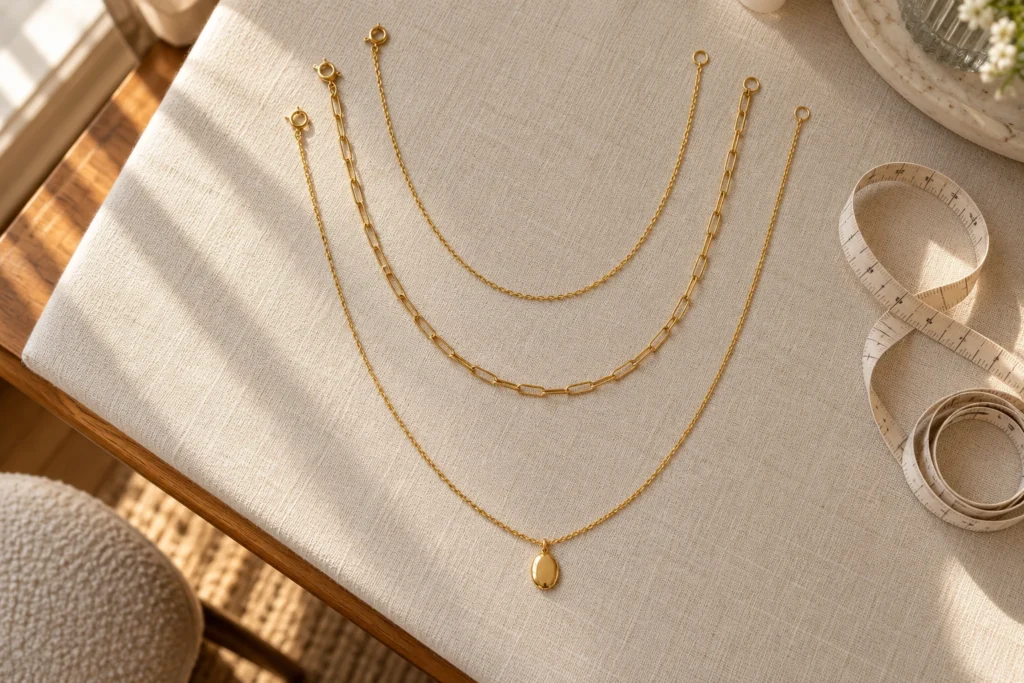
Try chains around 18 and 20 inches—approximately 46 and 51 cm—as an initial comparison, then adjust them on your body. Neck circumference, shoulder shape, bust, pendant size, and clothing all affect where the jewelry rests. Those measurements describe chain length, not a guaranteed position on the chest.
Use a soft tape measure to estimate the length you like, leaving comfortable room around your neck. Check whether a product’s stated measurement includes its extender and whether a pendant adds extra drop.
Choose one piece to lead: a favorite locket, a small stone, or a more substantial link chain. Add a quieter necklace above or below it. If both pieces have large pendants, move them farther apart or wear one on its own.
Use this neckline guide as a starting point:
| Neckline | Necklace arrangement to try |
|---|---|
| V-neck or open shirt | Two layers inside the opening, with the lower pendant above its point |
| Crewneck | Layers clearly above the collar or deliberately over the fabric |
| Turtleneck | Longer necklaces resting over a smooth knit |
| Scoop or square neck | Nested layers within the exposed area |
| Sweetheart | A compact stack, with a centered pendant clear of the fabric |
| Boat neck or off-the-shoulder | Short layers where there is comfortable room |
| One-shoulder | Fine, compact layers that clear the diagonal edge |
Before buying another chain, try the adjustment points on necklaces you already own. A compatible extender can change an awkward overlap into useful spacing.
V-Necks and Open Shirts: Keep the Pendant Inside the Opening
A V-neck already directs attention toward the center of the outfit. Layered necklaces usually look clearest when the lower pendant remains fully inside that opening.

With a V-Neck
Start with a short plain chain and a longer necklace carrying one small pendant. Let the pendant sit above the bottom of the V, with enough clearance to remain visible when you move.
A rounded pendant softens an angular neckline; a slim drop repeats its direction. Both approaches work. Pick the one that suits the outfit, and leave the other necklace simple.
For a practical daytime combination, try a burgundy V-neck knit, dark straight-leg jeans, brown loafers, and two fine gold-colored layers. The knit supplies texture, so the jewelry can stay restrained.
A deeper V gives you more space between necklaces, but you do not have to fill the entire opening. Two compact layers near the collarbones can look just as considered.
With an Open Shirt
Decide how far you want to unbutton the shirt before adjusting the necklaces. Keep the lowest pendant above the point where the placket closes. Chains that repeatedly slip beneath the collar are often easier to wear slightly shorter.
A white poplin shirt, charcoal trousers, and compact layers work for an office that permits jewelry. Softer linen gives the same combination a relaxed summer feel.
If you add a blazer, check the necklaces again with the jacket on. Its lapels can narrow the visible opening or push a longer pendant beneath the shirt.
Find more outfit options in our guide to styling a white button-down shirt.
Shop the Inspiration — Similar Style: Monica Vinader’s Fine Chain Necklace 17″ is an adjustable chain in 18k gold vermeil on sterling silver. Consider it as a short, simple layer if its maximum length of approximately 43 cm suits you.
View the Fine Chain Necklace at Monica Vinader
Shopping suggestions are similar styles. Select your country and check the current price, currency, available length, and delivery options before ordering.
Crewnecks and Turtlenecks: Decide Where the Jewelry Will Sit
Higher necklines change the background behind the jewelry. Decide whether the necklaces will sit on exposed skin or over the garment, then give them enough room to stay in that position.

With a Crewneck
A lower crewneck may leave space for two short chains above the collar. With a close-fitting, higher collar, try longer layers that fall clearly onto the T-shirt.
The awkward length is often the one that lands directly on the ribbed edge and keeps slipping underneath. Adjust that necklace until its lowest point clears the collar comfortably.
A silver-colored curb chain and a longer small pendant stand out against charcoal cotton. Add an open navy blazer, straight-leg jeans, and loafers for an everyday look.
Our casual blazer outfit ideas offer more ways to build around that base.
On a printed T-shirt, try slightly stronger chain shapes so the jewelry remains visible. Several very fine necklaces can become difficult to distinguish against a detailed graphic or busy pattern.
With a Turtleneck
Try two longer necklaces over a smooth, fine-gauge knit. Separate their lowest points and check that the shorter one does not press against the folded collar.
Against a cream turtleneck, a medium link chain and a longer pendant introduce different shapes without requiring several charms.
On chunky or loosely knitted fabric, inspect clasps, pendant edges, and settings for snagging. One smooth chain may be the more comfortable choice.
Put on your coat and scarf before making the final decision. A combination that sits neatly over a sweater can feel crowded once winter accessories are added.
Shop the Inspiration — Similar Style: Monica Vinader’s Fine Chain Necklace 24″, in 18k gold vermeil on sterling silver, offers a longer adjustable option at approximately 61 cm. Try a comparable length over your actual knit before deciding; fabric thickness changes the fit. The chain is sold separately from optional charms.
View the 24-Inch Chain at Monica Vinader
Scoop, Square, and Sweetheart Necklines: Work Within the Frame
Scoop, square, and sweetheart necklines expose a defined area of skin. Use that area as a frame, keeping the layers inside it with a visible margin above the garment.

Scoop Necklines
Rounded chains echo the neckline’s curve. Try a fine cable chain above a slightly longer textured chain, or add a small pendant to the lower layer.
A deep scoop offers more room; a shallow one may suit just two compact necklaces.
For a relaxed outfit, combine an olive scoop-neck top with cream trousers, flat sandals, and two fine gold-colored chains. The open neckline gives the jewelry enough visibility without requiring a large pendant.
Square Necklines
Curved jewelry provides a gentle contrast to straight garment edges. Keep the lowest pendant above the horizontal neckline so it does not repeatedly catch on that edge.
A navy square-neck top, stone trousers, silver-colored layers, and black flats create a useful dinner outfit without needing a dress.
Check the pendant while seated as well as standing, because the fabric can rise. If the necklace keeps landing on the neckline, shorten it slightly or choose a longer chain that rests clearly over the top.
Sweetheart Necklines
The shaped bodice already creates a focal point. Try a short plain chain and one centered pendant that stays above the neckline’s central dip.
If the bodice has beads, lace, or prominent seams, reduce the jewelry’s size or wear one necklace. A highly detailed neckline may need very little additional decoration.
There is also room to wear a long pendant deliberately over a plain top. Give it enough length to rest clearly on the fabric and check that it stays there through normal movement.
Shop the Inspiration — Similar Style: The gorjana Parker Mini Necklace is a slimmer link-chain option for adding texture beside a delicate pendant necklace you already own. Check the selected finish and sizing on the product page.
View the Parker Mini Necklace at gorjana
Wide and Asymmetric Necklines: Keep the Layers Compact
Wide and asymmetric necklines make the shoulder line part of the outfit. Compact necklace layers can leave that shape visible, provided they sit comfortably clear of the fabric.

Boat Necklines
Check the small area above the collar before choosing a choker. Some boat necks leave room for two delicate chains; others sit too high.
If there is little space, try longer necklaces over a smooth top or choose earrings instead.
Avoid forcing a short necklace into a gap that makes it feel tight. Comfort matters more than following a particular necklace arrangement.
Strapless and Off-the-Shoulder Necklines
A short chain and a slightly longer pendant can create a focal point between the neck and bodice.
Keep the pendant clear of the upper edge, particularly if the garment has a folded band, ruffle, or textured trim.
A black strapless dress with two fine gold-colored necklaces works for evening. Add a jacket for warmth, then check how its lapels interact with the jewelry.
On an off-the-shoulder knit, also check the neckline with your arms raised. Its position may shift enough to change where the lower necklace rests.
One-Shoulder Necklines
Try two very fine short chains above the highest part of the diagonal edge.
If the neckline reaches the base of your neck, comfortable clearance may be limited. A single small necklace or earrings can be an easier finish.
An asymmetric neckline does not require an asymmetric necklace arrangement. Keep the chains centered if that feels balanced, and let the garment supply the diagonal line.
Mix Metals and Textures Around One Focal Piece
Layered necklaces do not have to match in metal, width, or texture. They are easier to read when each piece has enough space and one element carries most of the visual weight.
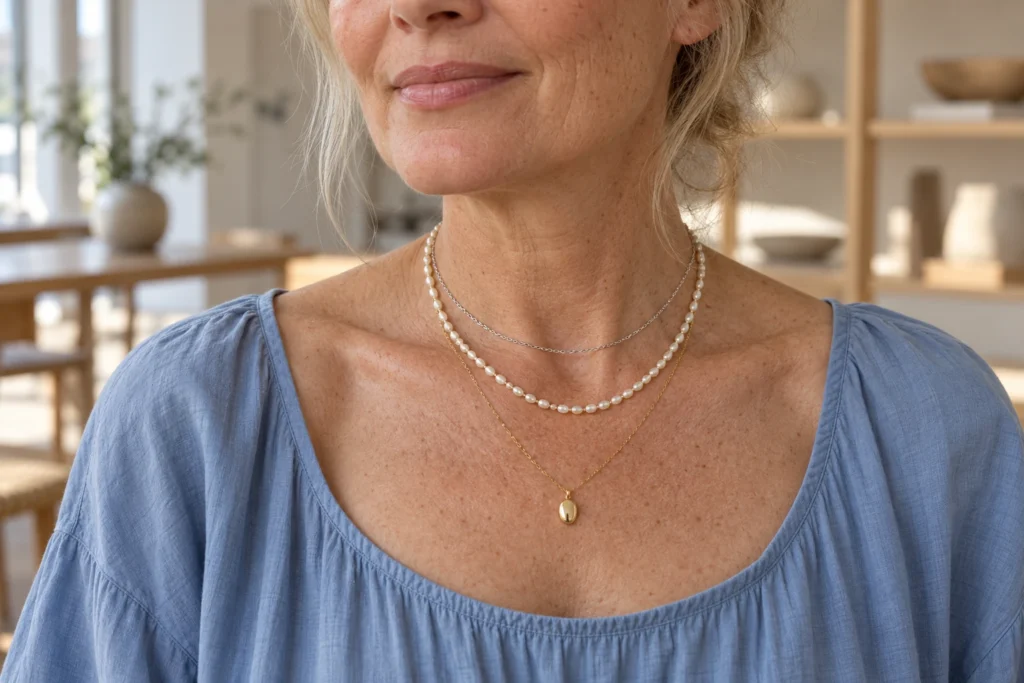
Try a fine silver-colored chain with a slightly longer gold-colored pendant. A two-tone piece can connect the colors, but it is optional. You also do not need to match every chain to your belt buckle, handbag clasp, or earrings.
If you want a quieter effect, repeat one metal in two places and use the other as a smaller accent.
To build more contrast, vary the shapes: a plain cable chain beside elongated links, or a smooth pendant below small beads.
Adding Pearls to a Necklace Stack
Pearls bring a softer surface into the mix. Try a short pearl strand between a fine chain and a longer pendant, with clear gaps between them.
Avoid arranging a rough metal edge where it will repeatedly rub against a pearl.
GIA’s pearl care guidance explains that pearls are vulnerable to scratching and chemicals such as perfume and cosmetics. Wipe them with a soft, clean cloth after wear and follow the care instructions for each piece.
Choosing Jewelry Against Clothing Colors
Consider the clothes as well as the jewelry itself.
Fine silver-colored chains may disappear against a pale print; a slightly stronger chain can be easier to see. Gold-colored jewelry gives a warm contrast to blue or charcoal, while silver-colored pieces can create a cooler finish.
Compare both in daylight rather than treating skin undertone as a restriction.
Our guide to matching clothing colors can help with the surrounding outfit.
Shop the Inspiration — Similar Style: Mejuri’s Pearl Charm Necklace combines freshwater cultured pearls with 18k gold vermeil. It offers a pearl layer with its own charm detail and construction.
View the Pearl Charm Necklace at Mejuri
Stop Tangles, Snagging, and Disappearing Pendants
A necklace combination should remain comfortable while you walk, sit, and turn your head.
If you keep separating pendants or pulling chains out of your collar, adjust the arrangement before adding another piece.
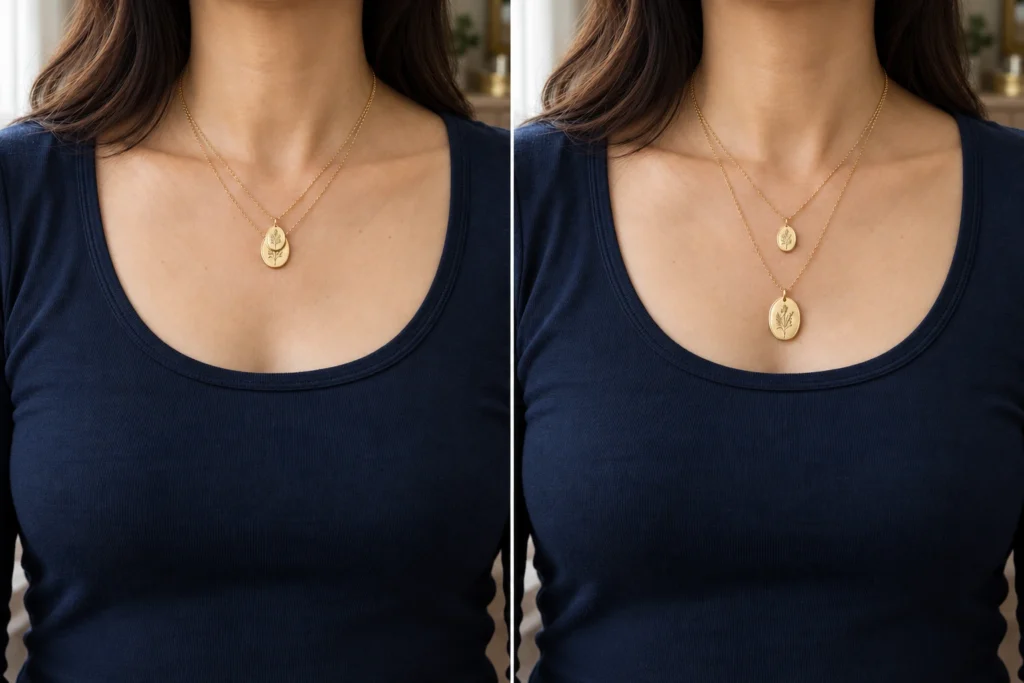
Start with these checks:
- Separate the lowest points. If two pendants overlap, lengthen one chain or shorten the other.
- Reduce moving parts. Two simple necklaces can be easier to manage than several fine chains with multiple charms.
- Inspect contact points. Check clasps and settings for anything that might catch a knit, lace, or loose hair.
- Check an extender’s fit. Its clasp must connect securely to the necklace’s end ring, and its weight should suit the chain.
- Try a necklace spacer cautiously. It may help organize clasps, but it cannot guarantee tangle-free wear and can feel bulky under a collar.
Different lengths and textures can help you distinguish the layers, but they do not prevent every tangle. Movement, hair, clothing, and chain construction still matter.
For a desk day, avoid a long pendant that knocks against the table when you lean forward.
For warm-weather wear, use lighter pieces if a heavier stack feels uncomfortable. In winter, put on your scarf and coat during the final check.
Take necklaces off before pulling a close-fitting top over your head. Store them separately, with chains laid out or individually supported, and follow the care directions for their materials.
Frequently Asked Questions
How many necklaces should you layer?
Two are enough to create a layered look. Add a third when it contributes a different length or texture and still leaves the pieces readable. A substantial chain may need only one fine companion.
Can you layer two necklaces with pendants?
Yes. Give the pendants distinct resting points, especially if they are similar in size. Try a smaller pendant above a larger one, then check the arrangement while seated. If they keep colliding, use one pendant with a plain chain.
Do necklace lengths have to be two inches apart?
No. A two-inch difference is a useful starting comparison, but the visible gap depends on your body, the chain’s shape, and any pendant. Adjust the actual placement instead of relying on a fixed spacing formula.
Can you wear layered necklaces with a patterned top?
Yes. Try two clearly separated chains with enough weight to show against the print. If the top has a busy collar, beadwork, or lace near the neckline, a simpler combination may be easier to see and more comfortable to wear.
How do you layer a necklace you wear every day?
Put on the everyday necklace first and treat its resting point as fixed. Add a plain chain above or below it, then check the neckline. If the garment keeps covering the important pendant, changing the top may work better than adding more jewelry.
Choose the Neckline First, Then the Necklaces
Put on your top before deciding on the final necklace lengths. Give each chain a clear place to sit, check the pendant against the garment edge, and move around before leaving the mirror.
You may finish with two fine chains inside a shirt collar, longer layers over a winter knit, or one favorite pendant on a busy neckline. The most useful combination is the one you can wear comfortably through the day.



2 thoughts on “How to Layer Necklaces With Different Necklines”